Apr 26, 2009

The middle path

The most common election day talking point was how we pointed to our index finger just before pressing someone's button and they asked for our digitus impudicus instead. In addition to this digital revolution, the marking of our franchise status was a long vertical line as opposed to the heavy dot of the past. Why this change, I do not know, but it did make for interesting post-poll conversations.

"Did you vote?", they would ask. You could conveniently show them the middle finger in response. It was even better if they hadn't voted, for the gesture could serve as double entendre.

Given that polling percentage in Pune was reported to be 40%, perhaps it is time for a "say छी! or "Don't mess with Texas" kind of in-your-face campaign. In मराठी, we could say: "vote करा, बोट दाखवा".2

Notes 1: I am not a Simpson or Ekalavya; I do possess a fifth finger which also happens to be a thumb.
2: meaning "vote and show (the) finger"

Apr 20, 2009

Page-churning

I join in. I listen. The line's weak. They join in one by one. Crackle. Splutter. Beeps.
Then he talks.
I wait. It's coming.
'This is the agenda. This is why we are here.'
I cringe. I cower. I wince. But it is inevitable.
'The main reason', he says, 'is so that'
as I run for the bomb shelter
'we are all on the same page.'

I would not want to be on even the same book shelf.

Apr 19, 2009

Move over Susan Sarandon

Shouldn't the upcoming TV show Rakhi ka Swayamvar actually be titled "The Rakhi Horror Picture Show"?

The Social Cripple

The social cripple arrives with all the grace of a chair missing its fourth leg. His awkwardness is ugly but not remarkable enough. No one would bother putting him beside the Elephant Man's tent to earn a quick buck off his display. So the first act of the cripple is to vanish into the wallpaper, but in doing so, trips over one of his left feet.

At this point, he makes his first mistake: he attempts insouciant laughter. It comes out as the gurgle of a disgruntled cistern. Somewhere in the room, a distinguished looking lady briefly turns her head in his direction, but gets back to her companion's twinkling chatter. But that distant action is sufficient to tug the carpet from under our cripple's cowering toes. To his eyes (which are too scared to look up at reality), the entire room is staring at him, agape in horror. "Who is this leper?", they demand in silent scream. "Did *you* invite him?", they seem to accuse each other.

The pretty girl who invited him has breezed over in her delightful mien. "Glad you could come". All the cripple's blood vessels begin to smash against his cheeks. Aware that he would begin snorting blood if the social pressure wasn't instantly released, our man makes the next mistake. He produces his underplayed smile. Underplaying is cool. Controlled. Suave. In reality, the cripple's smile comes out like a glare from the Count Dracula school of etiquette.

He watches as his hostess immediately puts the distance of several guests between them, and sighs. Why must he suffer so? They have parking spaces for the physically handicapped; guide dogs that cheerfully escort their masters to bungee jumps; gesture-controlled systems for Dr. Strangelove. But what about the socially challenged? Who will give us a sympathetic pat on the head, he thinks. And yes, unlike the others, he does want your sympathy.

Lost in such thought, the cripple fails to recognise the obnoxious one arrive beside him. He often runs into the obnoxious one because social gatherings had a way of spacing light years between themselves and these two. The cripple has his dignity and would not simply fall into the clutches of the creep just because he was the last man in society. But the social invalid's hints of boredom are as much of a washout as a fresh shower in the Atacama. The parasite clings on until dinner is served. The cripple wonders: what did that interaction cost him? Does everyone at the other end of the room think we are best buddies?

In the buffet line, he finds himself just behind an old classmate. They used to be close but then the chap got married and the ties withered away. Largely because he has no idea how to talk to someone's wife. Do you talk about exhibition sales? about home loans? implications of quantum string theories on Dirac's equations? He feels resentful against the education system that leaves him so severely incapacitated. Shouldn't the universities of the land teach useful things instead of chartered accountancy or COBOL or triple integrals? Meanwhile, the friend greets him with exuberance, and demands his phone number. Another social neuron in the cripple's circuitry blows past the blood-brain barrier. In unconscious reaction, he pulls out his own phone for support and presses a few buttons. "You keep your number in there as well?" chortles the friend. The wife, a keen curator of the husband's social network, plops a chicken leg on her plate in response.

Sitting by himself in a soothingly unlit corner, the least comfortable man in a two-mile radius ponders on the many detonations on the social minefield. In future, his strategic defence would consist of lying without remorse, to build a protective moat of excuses to ward off any invitation to any gathering of more than one. The first step towards that glorious future would be to dispose of plate and tissue without running into any friendly fire, and melt away like the Invisible Man on a New Moon Day during a game of Blindman's Buff.

As he walks down out of the side gate, he congratulates himself on the only success of the evening: all due to his supreme skills in making himself scarce. That too before the dancing & party games began. Then a car honks and he finds himself staring into the headlights of a stylish automobile. The car sidles up. The rear window goes down and he sees her, nay Her, looking out with a pleasant smile. "Going home? C'mon, I'll give you a lift".

She steamrolls his protestations and assures him that his company was worth more than he imagined. His two left feet were trying to stamp each other out, but somehow, he hop-skip-and-jumps his way into the seat beside her.

As soon as he sinks into the plush upholstery, he is a man transformed. It may have been the sharing of her secret - "these dos are such a nuisance, aren't they? I always long to get away. Don't you?" or just the cool air unsullied by the presence of unwanted Homo Sapiens in natty outfits. Ah, he speaks as confidently as a ice-skater who had just landed on his feet despite three Axel Paulsen jumps in zero gravity. Whether it was Sartre or the Kabaddi World Series, the evolution of slang in 90s rap or the Raaga Shivaranjani, the now-socially valid soars and dives, like a seagull having discovered Richard Bach in a corner of the local library.

As they draw outside his house, she holds her hand out and thanks him for his 'cerebral company'; how she ought to keep going to parties if only to meet rare birds like him. The car speeds off doing an insignificant 100 kmph as he becomes aware of the need to sit down.

Well, that hadn't been so bad, had it? Perhaps, if he had the tutelage of those like his most recent (and undoubtedly admiring) companion, he might one day surf the societal waves with a nonchalant glass of wine in one hand and a nary a worry in the other.

At that point, I'd like to have reported that our man slept the sleep of content, with fair angels strumming golden harps in accompaniment to his honeyed dreams. It might have been so, had he not performed that routine task of undressing in preparing for bed. For, it comes to his notice that his trouser zip was already undone.

And then began that bottomless vortex of excoriating social autopsy - how long...? did they..., what did he...?, when did I...? and so on.

There, for now, pauses the boring adventure of the social cripple.

Apr 7, 2009

What's your excuse for writing badly?

Seth Godin (I began reading the world's most famous marketer thanks to a tribal named Harish) wrote a very interesting post titled Why aren't you (really) good at graphic design?. He argued that even non-designers could become reasonably good at designs because both the tools and the know-how are available at no charge and one could, with a modicum of effort, be good enough to put together things like better powerpoints and webpages (or quizzes, says this blogger).

I'd like to ask a far more basic question to people that I encounter: Why are you so awful at writing? This isn't a call for people to write like Wodehouse or Rushdie, but a plea for decent, everyday writing that helps communicate your thoughts without distraction. That's all. And this isn't very hard to achieve.

And this isn't the rant of a language-Nazi who wants to impose pedantic norms. Over-flowery text will be as annoying as 'disemvoweled' utterances. Language evolves and good for it. But when you write 'dat is gud- u r abslutly rite. i appreciate ur thot' in a public forum such as an email to many or a blog post, it tells me that you're too sloppy to make sure your message will be received with the optimal attention. That kind of text has its place and time. Casualness is not a substitute for informality.

If you're reading this, then you'd be a writer: of emails, of status reports, of tweets, of scraps. Do you not know that we judge you by the word-trail you leave behind? How can you not want to be better at something you do each hour?

Largely, I attribute this to an ignorance or even willful blindness to the possibilities of elegance. (This from a person who is genetically awkward.) What prevents people from attempting to be concise yet meaningful, sharp yet elegant, rapid yet thoughtful? What's your excuse then?

Godin points to a Squidoo page of resources for design. Writing is so well-studied that I wouldn't know where to begin - so the easiest reference for anyone to have a look at would be Strunk and White's little book. That's pretty much all that's needed, one thinks.

Apr 4, 2009

Suresh Kalmadi and the cylinders

A flier with Suresh Kalmadi's election promises for Pune landed up with the newspaper. Largely on expected lines (Kalmadi has always taken the sports-global city track) Two items caught my eye. The first states his intention to "get the Olympics to Pune in 2020" which made me wonder if it was not possible to develop Pune sensibly without linking it to ambitious sporting events. The second promised to "make Pune a 'cylinder-free' city".

Unless I'm really out of touch with local realities, I wonder where this issue came from. First, I couldn't understand what kind of cylinder menace was implied here. Was this to bring piped gas to Pune as has been implemented in Thane? Is this really a major issue in Pune, as opposed to the usual roads/pollution/traffic/housing tracks that are far from being solved problems?

Mar 29, 2009

Twilight झोन

It is after-afterhours, and the ever-deepening sponge of despair that is Dev.D is out looking for more spirit to swab his lesions. He runs into a Beelzebub-like Chunni, who beckons him into a limbo hidden to the world by steel shutters. While he sits at the table, lights go off except for a spotlight. Under which a man, dressed in a three-piece suit, stands in front of a wall with LOADING PLEASE WAIT splashed on it. He peels his coat off, then pauses, almost as if he was waiting for permission, but no, he's just waiting for the music to catch up.

When it does, this dancer begins to move, as if imbued with the ghosts of Marceau and Jackson. He is rooted, but his limbs move geometrically, tracing staccato phrases in the air. Inter-cut camera circling Dev and demon. Another man joins the spotlight, they cross, and like synchronised swimmers before the sync-point, take up their places. Then they go, cutting into each other's space with mesmerising finesse.

Danny Boyle's credit swirls and eddies round Dev at a lower frame rate, as the gravelly voice makes way for a sitar. Dev goes off to drown - literally - his blood and his tears, in a place no one would see. He re-surfaces. There are now three players, lithe and fluid.

As the beats turn urgent, Dev rises and has a Snorricam bursting out of his chest. As the world around him staggers to stay on its feet, he is the fulcrum of our vision. In two ticks, he has stumbled into yet another unfamiliar world. This one's pink.

Pardesi from Dev.D - a superbly psychedelic experience.

Mar 28, 2009

How to ask Vishal Bhardwaj a question

Why, you stand up abruptly and shout out in garbled English before he can get away!

Last week, I attended a seminar on Cinema and Literature jointly organised by the Film & Television Institute of India (FTII) in Pune and the Film Writers Association. Here's the precursor post about that.

Which brings us back to the titular figure of this post. The last time I'd seen Vishal, he was much less celebrated as a film-maker and chose to remain silent. Here, he began with expressing his trepidation at speaking in front of legends such as Mani Kaul and Prof. U.R.Ananthamurthy, and didn't even want to look in the direction of his 'gardener' Gulzar. He then proceeded to shake off his nervousness with a couple of 'shers' and spoke of how Maqbool came about. He began by describing the days before Maachis in the land where 'mediocrity is worshipped', and how he tried gaining producers' attention by trying to pass of his original songs as copies of Pakistani songs (incredulous laughter sweeps the auditorium).

Heeding Gulzar's prophesy that Vishal would be a film-maker someday, he decided to try his hand at making films, partly with a view to employing himself as a music director (since his career seemed to be ending!). After Makdee (a story that was partly inspired from childhood memories of Enid Blyton), he wanted to make a film on the underworld ("because I like guns, crimes, and chases"), but felt most films ended in a gangwar, and lacked depth. Plus, what do you do that Ram Gopal Varma hadn't? Serendipitously, Anurag Kashyap had pointed him to Kurosawa's "Throne of Blood" and Alaap Mazgaonkar (who plays 'Mughal-e-Azam' in Makdee) had given him a book of stories containing Macbeth. Until then, he subscribed to the common view that 'literature' was high-brow and had no pulp or entertainment to offer. But here was a drama that gripped him.

He then read the full Macbeth ("Shakespeare language ek taraf, English duusri taraf") cover to cover. He and Abbas Tyrewala began to write, not encumbered by convention of what was allowed and what wasn't ("we were blessed with ignorance"). Making the witches into cops or turning Lady Macbeth into Abbaji's mistress happened. Naseeruddin Shah loved the script and gave him the confidence this would work, volunteering to play one of the cops instead of Abbaji as originally intended.

There was also a reference to an earlier FWA seminar where Javed Akhtar said: "In Maqbool, Shakespeare failed you; in Omkara, you failed Shakespeare" (according to this account, JA and others had torn into Omkara). Vishal ended by quoting Prof. U.R.Ananthamurthy's speech on the 1st day where the Jnanpith awardee talked about the difference in adapting just the 'structure' as opposed to 'texture'. Vishal said he had been paying more attention to structure than texture (though this blogger finds texture and ambience to be Vishal's key strength) and now had the confidence to write his own originals.

After reciting a parting couplet, he sat down. Govind Nihalani, chairing the session, said Vishal was off to catch a flight, so may be we had time for just one question. No one stirred (most sessions had gone question-less, a pity), so he was about to wish Vishal goodbye, when I decided to shoot my hand up.

There were many things to ask (that after disregarding Yasho's suggestion to yell "Kaminey!" out loud) but I settled for one on Vishal's other main writing source. "Could you tell us a little about your work with Ruskin Bond, and we've heard you're working with him again". Nihalani was about to brush me off for being a tad too late, but Vishal was kind enough to answer. He spoke of how he liked the story for The Blue Umbrella, but couldn't see how it would make a film of more than 30 minutes. He then hit upon the idea of the red umbrella, met Ruskin Bond who seemed to like the idea, and made the film. And yes, he was working on a few ideas with Bond (he mentioned a couple of names, but sadly, I couldn't quite figure them out - did he say "A Season of Ghosts"?).

And that was that.

A Times of India interview on the sidelines

Update: 5 Apr 2009
Ajay Bhramatmaj has a transcript of Vishal's speech here (the previous link is in Devanaagarii, here's a Roman script version).

Cross posted on our Vishal blog

Show and Tell: notes from a seminar on "Cinema and Literature"

Last week, I (along with a couple of fellow itinerants) attended a seminar on Cinema and Literature jointly organised by the Film & Television Institute of India (FTII) in Pune and the Film Writers Association (a trade union mainly of Bollywood writers). The idea was interesting: to explore the relationships between cinema and literature (sometimes symbiotic, sometimes parasitic). There was also the appealing prospect of watching (gawking?) and listening to people this blogger is quite a fan of.

The opening ceremony saw bodies spilling out of the little FTII auditorium (we had to uncomfortably stand/squat/sit for about 4 hours that day). The principal reason for the interest was perhaps the presence of both Gulzar and Javed Akhtar. True to perception, the former's speech contained the romance of wordplay as well as some pithy observations from film & lit history, while the latter made some strident points without mincing words. Akhtar spoke of the cinema-lit connection involving a love triangle: that of the audience, which affected what was adapted and how it was received. Refering to the ghastly 80s when mainstream Hindi films hit their nadir, he drew a connection between "sarkailo khaTiyaa" and "sarkailo masjid". Gulzar, on the other hand, asked whether it was necessary to be so aware of the audience all the time, and preferred films & literature to dance their duet. He asked an interesting question: how would cinema be if sound hadn't crept in? Would people still come looking to literature, now that words were not needed?

A common reference point throughout the two days was Saratchandra's Devdas, both in terms of number of adaptations, as well as its recency. Gulzar (or was it JA?) refered to it by pointing out that once upon a time Devdas would have been the lowest common denominator of its times! In the session on novel adaptations, Anurag Kashyap didn't bother trying to justify his choices too much - he described how he went about it. In general, there were two kinds of speakers: 'theorists' (usually writers, who spent a lot of time bemoaning adaptations and musing on its fickle nature) and 'practitioners' who seemed to be 'doing' things, trying them out, failing, learning, and moving on. It was the second category that produced the most engaging talks, and Kashyap was one of them.

A writer who spoke wonderfully, and had contrarian views to Kashyap, was Mamta Kalia. But in all, the sessions on novels, short stories and folklore were disappointing. A majority of panelists kept regressing to existential arguments (such as splitting hairs on words like 'inspiration' and 'adaptation', and didn't spend much time in discussing the nuts-and-bolts or challenges of these respective forms). Shama Zaidi tried to show some examples of how changes were made for Shatranj Ke Khiladi, but spoiled things by being too petulant and dismissive. Even the second day's session on mythology kept tracing issues of history and philosophy, but unlike the earlier sessions, it was considerably livened by a set of excellent speakers.

It helped that Kamalahassan was chairing the session. He didn't make a speech of his, but kept insisting the atheist in him was spoiling for a fight on the topic. Gollapudi Maruthi Rao, noted Telugu actor, spoke eloquently on the history of mythology in films (appropriately so; I think the Telugu film industry has made the best use of that material). Kamalahassan then made one his many clever sound-bite interjections: "According to me, mythology is spiritual cosmetic surgery for history; makes the truth more palatable". The man knows how to press all the right buttons on an audience!

Dr. Devdutt Patnaik was the next speaker, and he delivered a very interesting talk. Once a man of medicine, he's now a 'mythologist' and carries the rather exotic title of "Chief Belief Officer" at the Future Group. He spoke of mythology as the 'truth' of a culture, compared Western films about religion with Indian ones, and then plunged into an analysis of 'sanatan' vs social truths (which I found a little slippery to grapple with). At some points, it seemed he was about to invoke Hindu-glory-of-the-past (Kamal later quipped that he thought Patnaik was going to start distributing prasad on stage), but to his credit, he stayed on the side of sobreity throughout. I recommend a look at his presentation, which is available on his website here.

In response, Kamalahassan mentioned how he liked films that tried to be subversive about accepted wisdom, particularly mythology, and cited the example of (one of my favourite movies) The Life of Brian by Monty Python. He spoke of films like Hey! Ram into which elements of the Ramayana are interwoven. And did he blush ever so slightly when someone praised Dashavataram? The man is worth paying to go and listen to, I think.

The last session, the one on drama & plays, was the most well-rounded one: the speakers spoke both of theory and craft. Playwright Mahesh Elkunchwar spoke lucidly about his two experiences of writing his plays for film, as well as dealing with different constraints in the two media. Asghar Wajahat did the same later. Govind Nihalani, who directed Party from an Elkunchwar script, gave the view from the other side. Dr. Jabbar Patel spoke extensively of his collaborations with Vijay Tendulkar and Gulzar, and mentioned that in plays, it was the writer who ruled, while film was the director's medium.

Vishal Bhardwaj also spoke, but this is already such a long post that I've forked that encounter off into a separate post here.

In summary, it was a mixed set of talks. I liked something that Prof.U.R.Ananthamurthy said in his talk: that finally, all that really matters is how engaging the film (and I generalise it to all art) is for the individual viewer - whether you understand the content or crib about the fidelity of the film to the book is not all that important.

Times of India reports: Day 1, Day 2

Mar 27, 2009

Soft skills

Mulayam Singh Yadav has been in some lukewarm water with the Election Commission over a speech of his in which he was shown as saying, among others,:
"She (the District Magistrate of Mainpuri, his constituency) is a woman and that is why I am not making any comments on her. She should get her brain checked and should be aware of the fact that Mulayam is contesting from here (Mainpuri)", Singh was shown by local news channels as saying at the rally.
(source)

Among other improprieties, this comment has been found to be sexist because it makes references to the gender of the person involved. An observation here is that the comment is indeed sexist, but not misogynistic. In fact, the UP chief minister is kind enough to refrain from making further comments (untoward, we can guess) about the lady precisely because she is a lady. One would not like to imagine the fate of any male DM in her place.

One can see why Mr. Yadav opposes reservations for women in Parliament - it would severely cramp his style.

Mar 15, 2009

Glimpses of a genius: Buster Keaton

It's a pity that many of us ("even I") haven't seen much of 'Buster' Keaton's work. He does appear in quizzes, usually for the origin of his nickname, or as the name you'd guess in case the answer "Chaplin" was wrong.

Kamalahassan refers to Keaton quite often in some of his interviews. My first film viewing of Keaton was, ironically, in Chaplin's brilliant "Limelight", where the two giants of the erstwhile silent comedy era came together for a memorable duet (youtube link). The magic of this partnership is that both are playing out their own styles of comedy in tandem.

I have also watched some parts of The General, perhaps the most famous Keaton film, and was able to watch all of that stupendously choreographed locomotive sequence. In fact, Keaton's films are like great magic shows or symphonies: exceptionally well-timed and intricately designed.

In an article on PFC, Shripriya writes about another Keaton stunner called "Sherlock Jr." and points to two astoundingly crafted sequences. Look very carefully at both of them: even after you know how they were put together, you will still be rubbing your eyes at the ingenuity of it all.

Mar 10, 2009

Once I could see, now I have been blinded

Those of us who grew up watching sterile DD newscasts could scarcely imagine news programmes would become so annoying in the 21st century. Progress was flying cars and teleportation, not a 24x7 itch.

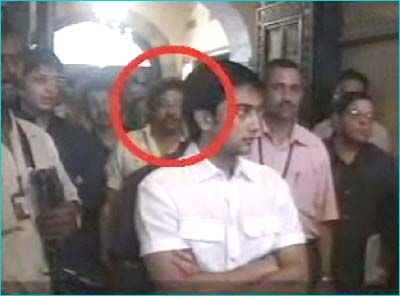
My latest peeve concerns the tendency of news videos to come with bright red lassos or arrows that move in relation to the video. Originally used to point our attention in grainy videos, this visual annotation now appears in almost every other news report. It is very reminiscent of the times when a similar 'innovation was handed to cricket commentators to emphasise some vague point they wanted to make. Invariably, the pointer would slip resulting in some unholy scribbles that even parents of kindergarten kids would be loath to praise.

The problem arises when perfectly clear pictures are defaced by a circle or an arrow. The end result is like watching the victim of a laser pointer attack - the poor chap has no idea a red circle is following him all over the screen. Worse are animated arrows that repeatedly keep poking the object of its affection - reminds me of all those "fling a shoe at Bush" flash games that did the rounds a few weeks ago.

This last mentioned menace appeared in a Times Now news report this evening about Sachin Tendulkar's absence from the next cricket match thanks to injury. In addition to a caption saying Internal Bleeding, an arrow kept poking at Tendulkar's rib cage. Despite the fact that it's internal. That we can eventually see him grimacing and holding his stomach. Forget about leaving it to the imagination, I haven't lent my eyes to Crimemaster Gogo to play marbles with. Another prominent member of the sac-red circle has been Ramgopal Verma while touring the Taj.

These marks have the unpleasant side-effect of instantly bumping anyone inside the circle to the level of an alleged criminal. What other conclusion could any visiting alien (from however advanced a civilisation) come to about a person thus outlined, other than he was worse than a dreg of Plutonic moondust: why else would the red circle keenly keep him in its sights like a hunting dog? To illustrate my point, see this composite image of the best of Indian TV (I hope NDTV doesn't sue me for saying that!): fine, upstanding journalists, with intensity and intent to break news written all over. And then observe, milord, the same exhibits with outlines straight out of The Omen.

You begin to sense the malignant cursors compelling you to haul them in front of the Inquisition. Brr.

Mar 8, 2009

The importance of an allegation

In recent times, eagle-eyed readers of the Times of India would have observed a curious typographical phenomenon in that newspaper. In stories such as this one about a crime in Pune, the word allegedly is italicised. Thus, in print, the article looks like this:
"The Haveli police on Saturday arrested Shekhar Shettiyar (28) of Kurla and booked five others for allegedly murdering Nathibai Chaudhary..."

"On June 26, 2001, the gang allegedly entered the shop posing as customers and stole the jewellery by threatening employees."

The motivation behind this oddity is unclear, and in the absence of the ToI style manual (if there is such a thing) in the public domain, it is hard to guess why this would be so. What is so special about the word "allegedly" that it needs to be highlighted thus?

Making it curious-er is the fact that there are many occurrences of the word in other ToI articles where it does not get such a treatment. Strange! (but not unusual for a paper whose curious 'case' of the perpendicular pronoun was remarked upon by this blog here.)

Notes
Incidentally, the ToI epaper doesn't provide the Pune edition any more, so I can't check if this formatting shows up in that version. It doesn't in the plain vanilla web version linked above.
Another blogger has made the very same puzzling observation.

Mar 6, 2009

Kaminey!

If you are a Vishal Bhardwaj fan but you haven't heard of Kaminey, you have got to read the Bardwatch here (or at George's).

Mar 1, 2009

Indian 'Word of the Year' - February updates

A note on the idea, words from Jan 2009, Feb 2009
February 2009's words

  1. Pink chaddis and other pinker-stinkers: February is the season of moralist protests in India, with forces for and against such manifestations of Western culture as Valentine's Day making headlines. This year took an unusual turn with a protest group launching a 'Pink Chaddi' campaign ('chaDDii'=='underwear') in reaction to an obscure radical group's actions. The coinage is clever and provocative, since it conjures up an instantly imaginable symbol and because 'chaDDii' is not always part of polite speech. From the point of view of this exercise, the phrase became even more interesting when counter-reactions applied the 'pink X' template to other apparel, including prophylactics. Is pink on its way to becoming the colour of Indian feminist action?

    Incidentally, the phrase moral police ought to be sent into some sort of Indian-ism 'Hall of Fame'. Though a phrase that is seen throughout the world, we seem to be the most fervent users of the phrase, as evidenced by a couple of anecdotal tests. 90% of the first three pages of Google search results for the word are India-related; this is also true of an archival news search.

  2. Jai Ho!: Remember Chak De? A phrase that sports crowds shouted lustily, a phrase that became synonymous with a coincidental and short-lived revival of Indian hockey, a phrase that hardly anyone uses. Does a similar fate await the aptly titled refrain from the Oscar winning song from Slumdog Millionaire (which also gave us another candidate last month)? The phrase, which is easy to utter and not unfamiliar to Indians, appeared in some newspaper headlines unrelated to the film . Just how much damage the constant drone of TV stories on the Oscar triumphs have done to us will be clear in a year's time.
A question to sign off: some of us have been using Slumdog as a sly euphemism to refer to scatalogical situations, usually to piss off our queasier colleagues. Tell me if you have noticed anything like this elsewhere.
January 2009's words

  1. Slumdog: a word that still has no entry in most dictionaries but shot into prominence after Danny Boyle's film and has even caused a lawsuit. Wow! An auspicious start for this list.
  2. 'Emosanal'/Emotional atyaachaar: A fertile phrase, coined by lyricist Amitabh Bhattacharyya director Anurag Kashyap, from the film Dev.D's soundtrack. I have seen several variants of this on some forums and music channels, using the phrase as X atyaachaar, which suggests a possible snowclone.
The fact that both of the above are connected to films says a lot about us Indians (or perhaps just me). We'll see how things evolve in the rest of this year.


The Whys
As a language and trivia enthusiast, I've always followed the American Dialect Society's Word of the Year. Why not an Indian Word of the Year?

Instead of trusting my cheese-like memory at the end of the year, it would be easier to record possible candidates along the way. This also opens up the possibility that some random observer will correct errors and add to the list.

What qualifies to be the Indian Word of the Year? I'm looking for interesting words or phrases that have been sufficiently interesting or news-worthy. This is not to be confused with a pure term-based 'Zeitgeist' - so Satyam will not be considered. Newly coined words will be invited. I'm also looking for words with 'potential' - that people mutate or mix with other words to form interesting variants. Perhaps even phrases that can become snowclones. So if people start making interesting things out of the word Satyam, then I'll include it. I admit I don't have it all figured out, but will do so as I do this.

Only English words? Not really. But limited by my own readings, my candidates are likely to be limited by language and geography. I'm hoping I'll be pointed to words by others.

For instance:
In Dec 2008, the relatively unknown phrase non-state actor would have been on the list.
In 2004, feel-good factor would have shone right in.
In addition, we would have take note of dard-e-disco last year - a strange phrase with some flexibility for reuse.

So to summarise: words that are interesting, not just news topics; words that have character; words that have newly entered our lexicon, and so on.

Feb 26, 2009

A Red Reading Room

"No weapons", he said.
I believed him.
I was a fool.

"We're gentlemen", he said.
I agreed.
He wasn't one.
(Don't believe that doctor.)

"By the ledge".
"Doesn't the spray make it slippery?".
He smiled and shook his head.

There I was, defenceless, staring into a Smith and Wesson.
"Jump", said Sherlock Holmes to me.

Feb 25, 2009

RMIM Puraskaar 2008 - the results

The soundtrack of Rock On emerged as the top Hindi film album of 2008 after a painstaking process of selection for the RMIM Puraskaar 2008. Academy Award winner (yay!) A.R.Rahman won Best Composer, while Javed Akhtar won Best Lyricist. The awards are a labour of love by Vinay Jain, who was kind enough to invite me to participate in the process as part of the jury (not that I have great music appreciation skills, but I am an enthusiastic listener :-)). I and 11 others spent about a month listening to the 70-plus shortlisted songs (see note on nomination process here), rating them on their individual components of music, lyrics, and singing, as well as the song as a whole.

Though lengthy, this was a highly enjoyable task and resulted in many fascinating questions on what I look for in a film song, and what kind of subliminal biases and preferences were in operation.

Vinay took our individual scores and comments, and compiled a list of winners in various categories. The results can be viewed here (the Hindi version here). The complete list of songs also contains comments made by various jury members. You'll spot that we were a varied bunch - mixed feelings were articulated and that is true of all listeners like us.

My picks for some of the categories were different, so even though these results show what the collective scores say, there is room for dissent. But I definitely agree with the decision not to award the Satish Kalra Sammaan to any 2008 film album. It was a relatively weak year for Hindi film music, despite its few bright spots. (In comparison, 2009 is already off to a smashing start with Dev.D and Delhi 6, with Vishal and others waiting in the wings).

Before I move on to reveal my personal picks, I would like to remind readers of that one of the principal aims of the puraskaar is "to have a review of the year's music and document it for posterity." (read this post for the whole premise). So, if you would like to record your opinions and disagreements, do send feedback to Vinay [giitaayan at gmail dot com] or leave a comment. Would love to hear them. The complete set of scoresheets is not available (I myself haven't seen any of the others) and is left to the discretion of the jury individual members to make available. I'd be happy to send my scores and comments to anyone who wants to have a dekko at them. Vinay's announcement on RMIM covers a few such details.

My own pick for top album was Jodhaa Akbar, which was a very tough choice to make out of my four candidates: Jodhaa Akbar, Jaane Tu..., Rock On!!, and Aamir. My summarised comments on these :

Aamir: had superb lyrics and very good music, especially for a debutant film music composer. It also had depth, with its lyrics forming a partnership with the music that was greater the sum of their parts. I thought it fell short on breadth, that's all.

Rock On!!: interesting concept, nice texture, loved the female solos; the lyrics and the singing (though acceptable for the film's concept) were where it went down a notch. Especially as in comparison to the others. I didn't give it the benefit of a 'rock' album, choosing to apply more conventional hindi film music parameters.

Jaane Tu...: like the film, the album went in familiar territory but managed to come out fresh. Full of pastel colours. But inherently, it didn't have the same depth for me. Perhaps it wasn't meant to.

Jodhaa Akbar: perhaps not everyone's choice of top album. IMHO, there was a lot of inventiveness in this particular album, especially in taking a period piece and applying modern touches to it - which needed some guts. As a result, this album sounds different from other Rahman 'period' soundtracks. The lyrics were competent, the arrangements superb, the melodies dulcet, and embellished the movie well.

Obviously, this is just a point of view. The exercise also illuminated the fact that despite what we hear on FM stations, a lot of decent Hindi film music gets made in one year, and sometimes there are quite a few minor gems that never get the attention they deserve. If a selection like this enables one to broaden one's mind just a touch, it'll have achieved some of its aims.
Previous results: 2006 and 2007
With thanks to friends who responded to a straw poll on Best Album

Feb 18, 2009

He's always on a tangent

The adventures of English in India have always been exciting to observe. Yet another reminder was served up today when a colleague received a rather innocuous email:
Dear [so-and-so],
Please find the attachment of resume. He is my cosine brother. He is in a software Eng.
One could not help but laugh (Harish had tears streaming down his face).

On reflection, this spelling makes a lot of phonetic sense. Initially, I thought this was a case of "when spell-checkers go wild". But thanks to the wisdom of "English is a very funny language" (a.k.a अंग्रेजी बड़ी अवैज्ञानिक भाषा है), I can see why there would be quite a few Indians making that mistake (as this Google search shows).

Thanks to Niranjan for inspiring the headline

Feb 17, 2009

Caliban's Sunrise

In Jeeves and the Feudal Spirit, that whiskered pill Percy Gorringe recites a poem about a man who, while watching the sun go down, comments:
"I say,
Doesn't that sunset remind you
Of a slice
Of underdone roast beef?"

Caliban at Sunset
I'm sure if Stilton Cheesewright, 'soulless clod' extraordinaire and muse for the poem, was to see this image of the morning sky from a few months ago, it would doubtlessly remind him of some scrambled eggs.

Feb 16, 2009

Tube Tales

In 1999, the London Magazine Time Out invited its readers to provide ideas for stories based on real life experiences in an around the metro's famous Tube. Eventually, this turned into Tube Tales (official link) - 9 little tales on the underground rail.

Most of the stories are brilliant, both in narration and content. Those rocking coffins have inspired a variety of minor sagas, differing in flavour and treatment. That famous names appear on-screen and behind the camera only enhances the appeal.

To choose from, there's the squirmingly funny H0rny (potentially uncomfortable if you have XY chromosomes!), the musically eloquent Bone (directed by Ewan McGrrreggorr), or the very clever Mr. Cool (Kelly Macdonald as the object of his attention) that opens the compilation. There are comic and dramatic twists, unexpected losses, the supernatural, and the poignant (like Jude Law's A Bird in the Hand). Add to them the pulsating background score.

Highly recommended (warning: NSFW at times). My viewing was courtesy the local British Library, but some of the segments may be available at online video shares.