Showing posts with label creativity. Show all posts

Sep 13, 2012

Yeh anda ki baat hai

I presume at some point in history, boiling an egg was an art - a minor, teensy-weensy one, but art nevertheless. Some people, the talented ones, intuitively knew exactly how long to keep it on the fire. The less talented ones had hit-and-miss days - you never knew what they would produce. The Gorans and Marats among the egg-boilers would produce a beautiful, soft yet firm, egg one day and on others, just hurl the egg at the referee and walk out. (At which point, the turbaned commentator would say: "you can't make omelettes without breaking any eggs".)


But today, in the time of timers and gas controls, egg boiling is science. Follow an algorithm, turn the heat on some H20 for 3/6/9 minutes, and almost everyone can be a yolk-star. I expect the problem went from art to science not in a series of DARPA-funded experiments that varied time, heat, and water, resulting in many post-doctoral positions, but via the obscure processes through which cultural wisdom develops over the ages.


Three cheers for cultural wisdom - which gave us much of what we love to eat (in the pre-molecular gastronomy days).


ok, this month, I actually, really, effectively learnt how to boil an egg with consistent results. Call it my Anda Andy Murray moment.

Jun 15, 2011

String theory

IBN Live quotes Extreme Tech, a technology website, as saying:
The innovative doodle that Google put up for the country and jazz guitarist, songwriter and inventor Les Paul resulted in $268 million in lost productivity.
The calculations are basically a house of cards made of slabs of back-of-the-envelope calculations built on a foundation of assumptions. Still, even if I ignore the number or method, the exercise annoys me. Consider the positives:
  • Several million+ people, who may not have heard of the pioneer Les Paul, now know who he was.
  • Instead of muddling 5 minutes on Facebook or Powerpoint or thinking about what they'd do after work, they spent time with a new toy, and some of their neurons (especially on the right hand side of the brain) welcomed the change.
  • They marveled at the current state of web technology and some of them resolved that day to learn to build such cool things.
  • By listening to what others had done with the audio-doodle, they figured out that great music can be made even from humble instruments. Some dusted off their old guitars and others made appointments with musically-inclined friends and teachers.
I wouldn't know how to calculate it, but I guess that whatever the loss to numerical productivity and annoyance to neighbours, the contribution to human knowledge and creativity was firmly in the black.

And if you want to pluck a few strings again, here you go.

Apr 27, 2010

Death by Bulletin

They say it is evil. They say it can be put to macabre ends. They say the Devil uses it in his daily briefings to the hapless denizens of the Elysian Fields (ok, I made this up).

Yes, that's how much people hate Powerpoint.

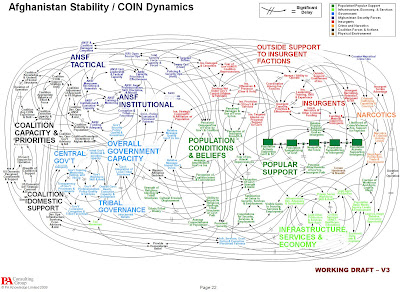
This image, from a Pentagon press briefing, has been doing the rounds in the interweb (is there a unified term for the blogosphere and the twitterverse, btw?). This NY Times article describes the surrounding peals of cynical mirth, as people tell each other - I told you, Powerpoint sucks - before going back to making their next 'deck' (need to brush harder tonight to get the taste of that word out!).

The problem has never been with Powerpoint as with the people using it. Even Edward Tufte, the Grand Duke of all things visual and a man who never hesitates in throwing his punches, criticizes the cognitive style of making slideware more than the tool itself. That the software makes it easy to throw out verbose texts and incoherent fragments in no time does not mean it has been spawned by Beelzebub himself during one of his ghoulish afternoons. This is one case where you should shoot the messenger (preferably with bullet points), and not the medium.

Take the above image. For one the resultant spaghetti has nothing to do with Powerpoint - it is at worst, a failure of depicting the information. In fact, one could even argue the image brilliantly depicts the hopelessly tangled web that is the Afghan situation! The choice of colours & clustering makes it a lot more palatable than some of the simpler images I have had the misfortune of seeing in several business presentations. We do not know how this slide was used and whether it was used to make a larger point of the complications, followed by diving into specific regions of this dense map.

The basic problem is that people gravitate towards using slideware as a communication medium even when it is not required. Hence, ppts show up in routine meetings merely as a visual notebook substitute for the presenter. Or they are used as means to document information. Hardly any presenter is taught effective use of a tool by way of the right techniques for narration, outline, slide & chart design, or using it as a complement to the presenter rather than a body double.

Fortunately, there's a ton of material available these days from which to learn. Garr Reynold's Presentation Zen is an excellent place to begin; there are many examples & contests on sites such as SlideShare; TED contains a wide ranging collection of different presentation styles; these are just a sample of resource map of people, ideas, and content devoted to telling better stories and sharing information effectively. If you are really serious about exploring an alternative to the entire philosophy of Powerpoint, try the awesomeness of Prezi. It provides a non-linear way of arranging your content, backed by some very pleasing frameworks for transition and narrative structure. In fact, this is so cool that it forces you to completely alter your way of thinking about presenting.

So put down the pitchfork, take your mouse away from the Add/Remove Programs, and take a deep look inside your slides before you get booked for cognitive murder.

Apr 15, 2010

Re-creative thinking

A couple of weeks ago, Scott Berkun tweeted something that I found quite interesting:
Many adults haven't *made* anything in yrs - giving them legos/crayons would help more than reading books on creativity
I wonder if this state of affairs is by unconscious design - reading creativity books seems like a proxy for action to its readers. It is immensely easier than picking up lego blocks or crayons. Children are not (yet) intimidated by a blank canvas or a vacuum, and not so scared about being told off for colouring outside the lines. So to those who want to be more creative, especially to those who know that there are answers in books, the first instinct may be to read about how to be creative, than to practise being creative. It makes you feel you are planning your steps towards that cherished goal without having to dip your toes in the cold water.

And sometimes (who knows) it might not turn out to be that cold!