Showing posts with label links. Show all posts

May 29, 2012

IZ 121: questions from the Infinite Zounds blog

I run Infinite Zounds, a daily quiz blog on topical themes.

I put together a set of 121 questions from the blog, from the period of 2010-11. There are 4 sets in all (and they include answers). Here be links to them:


Set 1: India, Sports, SciTech

Set 2: Books, Entertainment & Media, Language & Etymology

Set 3: VIZuals, Connections, Awards, & Obits

Set 4: Business and Economics, Social Sciences, Culture)

Sep 16, 2011

Faaaast and slw

From The Economist's column on language, an interesting pointer to a study paper in the "Language" Journal on why certain languages sound faster than others. Japanese is one of the fastest, and curiously Mandarin is on the slower side.

It's got to do with syllables, number of available sounds, and information density. Fascinating stuff. See The Economist for a summary and this TIME article for the details..

Oct 2, 2010

"Infinite Zounds" - a new quiz blog

I've started Infinite Zounds - a new blog that features (at least) one new question each day. There are quite a few quiz blogs around, but what's different about this blog is that the underlying theme is what is usually known as "Current Affairs". Each question is about something that was in the news recently and is contemporary in attention. So no questions about the Harappan civilisation, film noir from the 50s, the books of Raymond Chandler, or the performances of Kumar Sanu - unless they were in the news recently for some reason.

(In fact, it is highly unlikely that the blog will have any questions on Sanu - you can stop hyperventilating now.).

If you visit the blog, you will see that each post also contains the answer below in addition to the question. The answer is hidden, to let you hazard a guess in your head if you so choose to. I don't like going back to a blog the next day to find the answer, which is why I've done this.

You can subscribe to the blog via its feed. Unfortunately, this feed may contain the answer as well - that's something I haven't managed to solve, despite setting the feed to publish partially. Based on how things go, I might change the feed to full. Until then, if you subscribe via the default feed, consider a general spoiler alert to be in issuance.

An alternative is to follow the blog via Twitter or Google Buzz (or use the email id 'infinitezounds[at]gmail').

So, inviting you to take a look at Infinite Zounds, and see if the questions take your fancy. Let me know if it does.

Apr 28, 2010

On the loss of sleep and the sleep of loss

All Nighters is a collection of vignettes at the NY Times site on the subject of insomnia. The articles in this section are often thought-provoking, and the ailment seems to afflict too many people than seems tolerable.

Fortunately, I don't suffer from sleeplessness, but have had fleeting brushes with it during periods of illness. Those among us who sleep like careless infants perhaps do not know how fortunate they are. The whole cliché of realising what we have taken for granted when it is taken away from us is of no solace if you are up at night, tossing about after having numbered the entire sheep population of New Zealand.

The latest installment in All Nighters was particularly moving. Bill Hayes, a writer (of even a book on insomnia, called Sleep Demons: An Insomniac's Memoir1), writes about losing his partner who passed away, nay 'disappeared', in his sleep. In a grave irony, Hayes, a life-long insomniac, slept through it thanks to sleeping pills.

The blog post isn't just for insomniacs - it is for anyone who has lost someone or (dare I say it?) for everyone who will. Hayes writes:

[...] it was a long time before I was able to take his pillow from his side of the bed. I did not dare. The night after he died, I found that a sliver of light from a streetlamp shone through the blinds just so and cast a single yellowy tendril across his pillow. It was the opposite of a shadow. Which is as clear a definition as I can come up with for the soul.

With morning, the light was gone, and I found the days empty and agonizing. It would take about three years for this feeling to pass — a thousand days, give or take — people who had been through this told me. As it turns out, they were right. What no one said is something I discovered on my own: A thousand days is a thousand nights is a thousand chances to dream about him.


1: Hayes has also written a book on the two men behind Gray's Anatomy, which from what little I know of it, is an interesting story.

Aug 3, 2009

"Questionable Intelligence" - a Quiz!

It's that time of the year when I do a quiz in full contravention of the Geneva Convention. But hopefully, it will be fun.

Anand will be doing a Literature Quiz, the first for a BCQC Open.

Read this link for all the details.

Jun 30, 2009

What's in a name? Count for yourself

With the inauguration of yet another Rajiv Gandhi-named thingy, a look at the overall thingy leaderboard:

Rajiv Gandhi: 138
Chhatrapati Shivaji: 137
M.K.Gandhi: 68
Shakespeare: 1

With this, Rajiv Gandhi has taken a slender lead in the standings. With the Congress set to enjoy a full five year term at the Centre, he is likely to further strengthen his lead.

In the interest of keeping the drama in the race alive, certain people request you to vote for the Shiv Sena-BJP alliance in Maharashtra.


Suggested supplementary reading:
* A New Indian Express article on Gandhi, Gandhi everywhere,
* Atanu Dey on this practice: 1, 2

Given this, one wonders if Mayawati's double-handed backhand of playing 'statue' is just another variant of this game of iconography. If so, she seems to get greater flak for merely not mastering the nuances of the game.

Growing big in Kolkata

Prof. Soumen Chakrabarti is a faculty member at IIT Bombay's Computer Science department (and one of the top researchers in his field in the world). Like several professors in such institutes, he gets emails from wannabe interns/project seekers. Perhaps some are of the 'academic hunger' type, but a few are just looking for CV embellishments & recommendations for higher studies.

Prof. Chakrabarti's webpage carries a prominent notice stating:

At the moment I am not offering short-term projects to students not enrolled in a regular program at IIT Bombay.
Despite that, he seems to receive correspondence hoping for the opposite, some of which is painfully delightful. He has a sample on his blog (here), under the heading: "Can't read but will apply". Such as:
[...]I am an International Rifle Shooter of India and I was a member of an INDIAN AIR RIFLE SHOOTING TEAM FOR YEAR 2006. I am a presently studding in a 7th semester of B.E. Information Technology at LLLL DDDD Engineering College, AAAA, GGGG. [...] I am sending my Resume with this. I am sure that you would kindly cooperate and oblige.
Soumen Chakrabarti comments:
How could I possibly refuse from the wrong end of a Remington?
It gets even more interesting. Quoting from the entry:
Then there is in-your-face dishonesty:
"I have gone through your research activities given on your homepage. I am looking for a challenging opportunity for summer internship for the period of May-July 2007."

When I pointed out that anyone reading my homepage would notice my statement (that I do not take external students), I got a response like this:
"it's fine if u donot want to work with me ,but such words don't suit a proff of ur standards"

Clearly there is no dearth of entitlement, just good sense.

The exchanges seem to have become more hostile in recent times, with Soumen Chakrabarti receiving email that criticises him for either his hiring policy or for making these instances public (see end of the post).

He ends with this statement that really pinches:

It's hard to overstress the liability of a nation of a billion people out of which 700 million are functionally illiterate and the rest have no wish to follow instructions, even when they are asking for a favor.
These accounts are both hilarious and depressing. We need to satisfy the demand for higher-quality education, get more good professors teaching, have fewer people attempting to bull-doze their way into cosmetic achievements on paper, and for someone to tell these people that the simplest way to stand out is to use the bits of grey matter bestowed by nature on them in a fit of pure chance.

Link to the post here

Jun 23, 2009

I'm anal-ytical like that

Each morning, for the last couple of years, I have made a little health log in a journal about the previous day. This record comprises of any colds or niggles, exercise, weather, amount of sleep, medicines taken, and ends with a 'discomfort' & 'mood' rating (on a 1-5 scale).

(It sounds unbelievably anal-retentive, but I've always been a list maker: of normal things like books read & movies watched, and of stranger things like 'coincidences'.)

Harish, knowing of such heavy logging, pointed me to this Wired article about how many people seem to be doing this, and are using the Web to record & share such information. I began noting this info so as to better understand what influences my health and to spot & prepare for seasonal & other factors. I have a large mass of data now, but perhaps not a lot of insights.

Still, I continue to do so largely because I think I like recording information. Leading a trivia-monger's life smooths away any objections to pointlessness - why, someday, all of this may come in handy.

I'd really like to get my hands on some of the tools mentioned in the article - when, with each step I take, a bean counter wriggles in ecstacy.

Jun 9, 2009

A certain calming order has returned to the tennis world. One might even say some larks have rediscovered the wing, as did the snail the thorn, while God takes up the comfy armchair in heaven, and Browning may even be fooled into thinking the world's not such a bad place after all.

I refer, of course, to Roger Federer nailing his place on top of the mantelpiece with the win at Roland Garros. The win may even set his career carefree, with very little left to prove to himself.

He may even stop uncorking the tap of tears that has become such a feature of post-final presentations. Talk about climate change.

There remains the minor trifle of not having beaten Rafael Nadal at Paris, but I wouldn't be too unhappy if his career ended like that. It could be his 99.94, giving us something to debate for the rest of lives. No one should be that perfect.

***

Switching sports for second, I'm very happy that Rohit Sharma has moved to the top of the Indian batting order. He answers my prayer for a modern-day batsman who can oozes grace like an Arab oil pipeline from the 1960s. Batting first means his playing time is more predictable. Who else can you really watch?

***

Back to the clay. I had missed Fernando Gonzalez's astonishing backside play, and found a video online. It is simply the most crazy thing I have ever seen on a tennis court (or on its sidelines). Here is the human eraser:

Apr 26, 2009

The middle path

The most common election day talking point was how we pointed to our index finger just before pressing someone's button and they asked for our digitus impudicus instead. In addition to this digital revolution, the marking of our franchise status was a long vertical line as opposed to the heavy dot of the past. Why this change, I do not know, but it did make for interesting post-poll conversations.

"Did you vote?", they would ask. You could conveniently show them the middle finger in response. It was even better if they hadn't voted, for the gesture could serve as double entendre.

Given that polling percentage in Pune was reported to be 40%, perhaps it is time for a "say छी! or "Don't mess with Texas" kind of in-your-face campaign. In मराठी, we could say: "vote करा, बोट दाखवा".2

Notes 1: I am not a Simpson or Ekalavya; I do possess a fifth finger which also happens to be a thumb.
2: meaning "vote and show (the) finger"

Mar 29, 2009

Twilight झोन

It is after-afterhours, and the ever-deepening sponge of despair that is Dev.D is out looking for more spirit to swab his lesions. He runs into a Beelzebub-like Chunni, who beckons him into a limbo hidden to the world by steel shutters. While he sits at the table, lights go off except for a spotlight. Under which a man, dressed in a three-piece suit, stands in front of a wall with LOADING PLEASE WAIT splashed on it. He peels his coat off, then pauses, almost as if he was waiting for permission, but no, he's just waiting for the music to catch up.

When it does, this dancer begins to move, as if imbued with the ghosts of Marceau and Jackson. He is rooted, but his limbs move geometrically, tracing staccato phrases in the air. Inter-cut camera circling Dev and demon. Another man joins the spotlight, they cross, and like synchronised swimmers before the sync-point, take up their places. Then they go, cutting into each other's space with mesmerising finesse.

Danny Boyle's credit swirls and eddies round Dev at a lower frame rate, as the gravelly voice makes way for a sitar. Dev goes off to drown - literally - his blood and his tears, in a place no one would see. He re-surfaces. There are now three players, lithe and fluid.

As the beats turn urgent, Dev rises and has a Snorricam bursting out of his chest. As the world around him staggers to stay on its feet, he is the fulcrum of our vision. In two ticks, he has stumbled into yet another unfamiliar world. This one's pink.

Pardesi from Dev.D - a superbly psychedelic experience.

Mar 28, 2009

Show and Tell: notes from a seminar on "Cinema and Literature"

Last week, I (along with a couple of fellow itinerants) attended a seminar on Cinema and Literature jointly organised by the Film & Television Institute of India (FTII) in Pune and the Film Writers Association (a trade union mainly of Bollywood writers). The idea was interesting: to explore the relationships between cinema and literature (sometimes symbiotic, sometimes parasitic). There was also the appealing prospect of watching (gawking?) and listening to people this blogger is quite a fan of.

The opening ceremony saw bodies spilling out of the little FTII auditorium (we had to uncomfortably stand/squat/sit for about 4 hours that day). The principal reason for the interest was perhaps the presence of both Gulzar and Javed Akhtar. True to perception, the former's speech contained the romance of wordplay as well as some pithy observations from film & lit history, while the latter made some strident points without mincing words. Akhtar spoke of the cinema-lit connection involving a love triangle: that of the audience, which affected what was adapted and how it was received. Refering to the ghastly 80s when mainstream Hindi films hit their nadir, he drew a connection between "sarkailo khaTiyaa" and "sarkailo masjid". Gulzar, on the other hand, asked whether it was necessary to be so aware of the audience all the time, and preferred films & literature to dance their duet. He asked an interesting question: how would cinema be if sound hadn't crept in? Would people still come looking to literature, now that words were not needed?

A common reference point throughout the two days was Saratchandra's Devdas, both in terms of number of adaptations, as well as its recency. Gulzar (or was it JA?) refered to it by pointing out that once upon a time Devdas would have been the lowest common denominator of its times! In the session on novel adaptations, Anurag Kashyap didn't bother trying to justify his choices too much - he described how he went about it. In general, there were two kinds of speakers: 'theorists' (usually writers, who spent a lot of time bemoaning adaptations and musing on its fickle nature) and 'practitioners' who seemed to be 'doing' things, trying them out, failing, learning, and moving on. It was the second category that produced the most engaging talks, and Kashyap was one of them.

A writer who spoke wonderfully, and had contrarian views to Kashyap, was Mamta Kalia. But in all, the sessions on novels, short stories and folklore were disappointing. A majority of panelists kept regressing to existential arguments (such as splitting hairs on words like 'inspiration' and 'adaptation', and didn't spend much time in discussing the nuts-and-bolts or challenges of these respective forms). Shama Zaidi tried to show some examples of how changes were made for Shatranj Ke Khiladi, but spoiled things by being too petulant and dismissive. Even the second day's session on mythology kept tracing issues of history and philosophy, but unlike the earlier sessions, it was considerably livened by a set of excellent speakers.

It helped that Kamalahassan was chairing the session. He didn't make a speech of his, but kept insisting the atheist in him was spoiling for a fight on the topic. Gollapudi Maruthi Rao, noted Telugu actor, spoke eloquently on the history of mythology in films (appropriately so; I think the Telugu film industry has made the best use of that material). Kamalahassan then made one his many clever sound-bite interjections: "According to me, mythology is spiritual cosmetic surgery for history; makes the truth more palatable". The man knows how to press all the right buttons on an audience!

Dr. Devdutt Patnaik was the next speaker, and he delivered a very interesting talk. Once a man of medicine, he's now a 'mythologist' and carries the rather exotic title of "Chief Belief Officer" at the Future Group. He spoke of mythology as the 'truth' of a culture, compared Western films about religion with Indian ones, and then plunged into an analysis of 'sanatan' vs social truths (which I found a little slippery to grapple with). At some points, it seemed he was about to invoke Hindu-glory-of-the-past (Kamal later quipped that he thought Patnaik was going to start distributing prasad on stage), but to his credit, he stayed on the side of sobreity throughout. I recommend a look at his presentation, which is available on his website here.

In response, Kamalahassan mentioned how he liked films that tried to be subversive about accepted wisdom, particularly mythology, and cited the example of (one of my favourite movies) The Life of Brian by Monty Python. He spoke of films like Hey! Ram into which elements of the Ramayana are interwoven. And did he blush ever so slightly when someone praised Dashavataram? The man is worth paying to go and listen to, I think.

The last session, the one on drama & plays, was the most well-rounded one: the speakers spoke both of theory and craft. Playwright Mahesh Elkunchwar spoke lucidly about his two experiences of writing his plays for film, as well as dealing with different constraints in the two media. Asghar Wajahat did the same later. Govind Nihalani, who directed Party from an Elkunchwar script, gave the view from the other side. Dr. Jabbar Patel spoke extensively of his collaborations with Vijay Tendulkar and Gulzar, and mentioned that in plays, it was the writer who ruled, while film was the director's medium.

Vishal Bhardwaj also spoke, but this is already such a long post that I've forked that encounter off into a separate post here.

In summary, it was a mixed set of talks. I liked something that Prof.U.R.Ananthamurthy said in his talk: that finally, all that really matters is how engaging the film (and I generalise it to all art) is for the individual viewer - whether you understand the content or crib about the fidelity of the film to the book is not all that important.

Times of India reports: Day 1, Day 2

Mar 27, 2009

Soft skills

Mulayam Singh Yadav has been in some lukewarm water with the Election Commission over a speech of his in which he was shown as saying, among others,:
"She (the District Magistrate of Mainpuri, his constituency) is a woman and that is why I am not making any comments on her. She should get her brain checked and should be aware of the fact that Mulayam is contesting from here (Mainpuri)", Singh was shown by local news channels as saying at the rally.
(source)

Among other improprieties, this comment has been found to be sexist because it makes references to the gender of the person involved. An observation here is that the comment is indeed sexist, but not misogynistic. In fact, the UP chief minister is kind enough to refrain from making further comments (untoward, we can guess) about the lady precisely because she is a lady. One would not like to imagine the fate of any male DM in her place.

One can see why Mr. Yadav opposes reservations for women in Parliament - it would severely cramp his style.

Mar 15, 2009

Glimpses of a genius: Buster Keaton

It's a pity that many of us ("even I") haven't seen much of 'Buster' Keaton's work. He does appear in quizzes, usually for the origin of his nickname, or as the name you'd guess in case the answer "Chaplin" was wrong.

Kamalahassan refers to Keaton quite often in some of his interviews. My first film viewing of Keaton was, ironically, in Chaplin's brilliant "Limelight", where the two giants of the erstwhile silent comedy era came together for a memorable duet (youtube link). The magic of this partnership is that both are playing out their own styles of comedy in tandem.

I have also watched some parts of The General, perhaps the most famous Keaton film, and was able to watch all of that stupendously choreographed locomotive sequence. In fact, Keaton's films are like great magic shows or symphonies: exceptionally well-timed and intricately designed.

In an article on PFC, Shripriya writes about another Keaton stunner called "Sherlock Jr." and points to two astoundingly crafted sequences. Look very carefully at both of them: even after you know how they were put together, you will still be rubbing your eyes at the ingenuity of it all.

Mar 10, 2009

Once I could see, now I have been blinded

Those of us who grew up watching sterile DD newscasts could scarcely imagine news programmes would become so annoying in the 21st century. Progress was flying cars and teleportation, not a 24x7 itch.

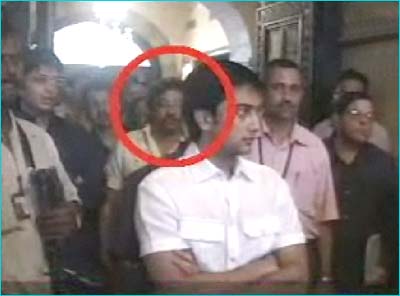
My latest peeve concerns the tendency of news videos to come with bright red lassos or arrows that move in relation to the video. Originally used to point our attention in grainy videos, this visual annotation now appears in almost every other news report. It is very reminiscent of the times when a similar 'innovation was handed to cricket commentators to emphasise some vague point they wanted to make. Invariably, the pointer would slip resulting in some unholy scribbles that even parents of kindergarten kids would be loath to praise.

The problem arises when perfectly clear pictures are defaced by a circle or an arrow. The end result is like watching the victim of a laser pointer attack - the poor chap has no idea a red circle is following him all over the screen. Worse are animated arrows that repeatedly keep poking the object of its affection - reminds me of all those "fling a shoe at Bush" flash games that did the rounds a few weeks ago.

This last mentioned menace appeared in a Times Now news report this evening about Sachin Tendulkar's absence from the next cricket match thanks to injury. In addition to a caption saying Internal Bleeding, an arrow kept poking at Tendulkar's rib cage. Despite the fact that it's internal. That we can eventually see him grimacing and holding his stomach. Forget about leaving it to the imagination, I haven't lent my eyes to Crimemaster Gogo to play marbles with. Another prominent member of the sac-red circle has been Ramgopal Verma while touring the Taj.

These marks have the unpleasant side-effect of instantly bumping anyone inside the circle to the level of an alleged criminal. What other conclusion could any visiting alien (from however advanced a civilisation) come to about a person thus outlined, other than he was worse than a dreg of Plutonic moondust: why else would the red circle keenly keep him in its sights like a hunting dog? To illustrate my point, see this composite image of the best of Indian TV (I hope NDTV doesn't sue me for saying that!): fine, upstanding journalists, with intensity and intent to break news written all over. And then observe, milord, the same exhibits with outlines straight out of The Omen.

You begin to sense the malignant cursors compelling you to haul them in front of the Inquisition. Brr.

Mar 8, 2009

The importance of an allegation

In recent times, eagle-eyed readers of the Times of India would have observed a curious typographical phenomenon in that newspaper. In stories such as this one about a crime in Pune, the word allegedly is italicised. Thus, in print, the article looks like this:
"The Haveli police on Saturday arrested Shekhar Shettiyar (28) of Kurla and booked five others for allegedly murdering Nathibai Chaudhary..."

"On June 26, 2001, the gang allegedly entered the shop posing as customers and stole the jewellery by threatening employees."

The motivation behind this oddity is unclear, and in the absence of the ToI style manual (if there is such a thing) in the public domain, it is hard to guess why this would be so. What is so special about the word "allegedly" that it needs to be highlighted thus?

Making it curious-er is the fact that there are many occurrences of the word in other ToI articles where it does not get such a treatment. Strange! (but not unusual for a paper whose curious 'case' of the perpendicular pronoun was remarked upon by this blog here.)

Notes
Incidentally, the ToI epaper doesn't provide the Pune edition any more, so I can't check if this formatting shows up in that version. It doesn't in the plain vanilla web version linked above.
Another blogger has made the very same puzzling observation.

Mar 1, 2009

Indian 'Word of the Year' - February updates

A note on the idea, words from Jan 2009, Feb 2009
February 2009's words

  1. Pink chaddis and other pinker-stinkers: February is the season of moralist protests in India, with forces for and against such manifestations of Western culture as Valentine's Day making headlines. This year took an unusual turn with a protest group launching a 'Pink Chaddi' campaign ('chaDDii'=='underwear') in reaction to an obscure radical group's actions. The coinage is clever and provocative, since it conjures up an instantly imaginable symbol and because 'chaDDii' is not always part of polite speech. From the point of view of this exercise, the phrase became even more interesting when counter-reactions applied the 'pink X' template to other apparel, including prophylactics. Is pink on its way to becoming the colour of Indian feminist action?

    Incidentally, the phrase moral police ought to be sent into some sort of Indian-ism 'Hall of Fame'. Though a phrase that is seen throughout the world, we seem to be the most fervent users of the phrase, as evidenced by a couple of anecdotal tests. 90% of the first three pages of Google search results for the word are India-related; this is also true of an archival news search.

  2. Jai Ho!: Remember Chak De? A phrase that sports crowds shouted lustily, a phrase that became synonymous with a coincidental and short-lived revival of Indian hockey, a phrase that hardly anyone uses. Does a similar fate await the aptly titled refrain from the Oscar winning song from Slumdog Millionaire (which also gave us another candidate last month)? The phrase, which is easy to utter and not unfamiliar to Indians, appeared in some newspaper headlines unrelated to the film . Just how much damage the constant drone of TV stories on the Oscar triumphs have done to us will be clear in a year's time.
A question to sign off: some of us have been using Slumdog as a sly euphemism to refer to scatalogical situations, usually to piss off our queasier colleagues. Tell me if you have noticed anything like this elsewhere.
January 2009's words

  1. Slumdog: a word that still has no entry in most dictionaries but shot into prominence after Danny Boyle's film and has even caused a lawsuit. Wow! An auspicious start for this list.
  2. 'Emosanal'/Emotional atyaachaar: A fertile phrase, coined by lyricist Amitabh Bhattacharyya director Anurag Kashyap, from the film Dev.D's soundtrack. I have seen several variants of this on some forums and music channels, using the phrase as X atyaachaar, which suggests a possible snowclone.
The fact that both of the above are connected to films says a lot about us Indians (or perhaps just me). We'll see how things evolve in the rest of this year.


The Whys
As a language and trivia enthusiast, I've always followed the American Dialect Society's Word of the Year. Why not an Indian Word of the Year?

Instead of trusting my cheese-like memory at the end of the year, it would be easier to record possible candidates along the way. This also opens up the possibility that some random observer will correct errors and add to the list.

What qualifies to be the Indian Word of the Year? I'm looking for interesting words or phrases that have been sufficiently interesting or news-worthy. This is not to be confused with a pure term-based 'Zeitgeist' - so Satyam will not be considered. Newly coined words will be invited. I'm also looking for words with 'potential' - that people mutate or mix with other words to form interesting variants. Perhaps even phrases that can become snowclones. So if people start making interesting things out of the word Satyam, then I'll include it. I admit I don't have it all figured out, but will do so as I do this.

Only English words? Not really. But limited by my own readings, my candidates are likely to be limited by language and geography. I'm hoping I'll be pointed to words by others.

For instance:
In Dec 2008, the relatively unknown phrase non-state actor would have been on the list.
In 2004, feel-good factor would have shone right in.
In addition, we would have take note of dard-e-disco last year - a strange phrase with some flexibility for reuse.

So to summarise: words that are interesting, not just news topics; words that have character; words that have newly entered our lexicon, and so on.

Feb 25, 2009

RMIM Puraskaar 2008 - the results

The soundtrack of Rock On emerged as the top Hindi film album of 2008 after a painstaking process of selection for the RMIM Puraskaar 2008. Academy Award winner (yay!) A.R.Rahman won Best Composer, while Javed Akhtar won Best Lyricist. The awards are a labour of love by Vinay Jain, who was kind enough to invite me to participate in the process as part of the jury (not that I have great music appreciation skills, but I am an enthusiastic listener :-)). I and 11 others spent about a month listening to the 70-plus shortlisted songs (see note on nomination process here), rating them on their individual components of music, lyrics, and singing, as well as the song as a whole.

Though lengthy, this was a highly enjoyable task and resulted in many fascinating questions on what I look for in a film song, and what kind of subliminal biases and preferences were in operation.

Vinay took our individual scores and comments, and compiled a list of winners in various categories. The results can be viewed here (the Hindi version here). The complete list of songs also contains comments made by various jury members. You'll spot that we were a varied bunch - mixed feelings were articulated and that is true of all listeners like us.

My picks for some of the categories were different, so even though these results show what the collective scores say, there is room for dissent. But I definitely agree with the decision not to award the Satish Kalra Sammaan to any 2008 film album. It was a relatively weak year for Hindi film music, despite its few bright spots. (In comparison, 2009 is already off to a smashing start with Dev.D and Delhi 6, with Vishal and others waiting in the wings).

Before I move on to reveal my personal picks, I would like to remind readers of that one of the principal aims of the puraskaar is "to have a review of the year's music and document it for posterity." (read this post for the whole premise). So, if you would like to record your opinions and disagreements, do send feedback to Vinay [giitaayan at gmail dot com] or leave a comment. Would love to hear them. The complete set of scoresheets is not available (I myself haven't seen any of the others) and is left to the discretion of the jury individual members to make available. I'd be happy to send my scores and comments to anyone who wants to have a dekko at them. Vinay's announcement on RMIM covers a few such details.

My own pick for top album was Jodhaa Akbar, which was a very tough choice to make out of my four candidates: Jodhaa Akbar, Jaane Tu..., Rock On!!, and Aamir. My summarised comments on these :

Aamir: had superb lyrics and very good music, especially for a debutant film music composer. It also had depth, with its lyrics forming a partnership with the music that was greater the sum of their parts. I thought it fell short on breadth, that's all.

Rock On!!: interesting concept, nice texture, loved the female solos; the lyrics and the singing (though acceptable for the film's concept) were where it went down a notch. Especially as in comparison to the others. I didn't give it the benefit of a 'rock' album, choosing to apply more conventional hindi film music parameters.

Jaane Tu...: like the film, the album went in familiar territory but managed to come out fresh. Full of pastel colours. But inherently, it didn't have the same depth for me. Perhaps it wasn't meant to.

Jodhaa Akbar: perhaps not everyone's choice of top album. IMHO, there was a lot of inventiveness in this particular album, especially in taking a period piece and applying modern touches to it - which needed some guts. As a result, this album sounds different from other Rahman 'period' soundtracks. The lyrics were competent, the arrangements superb, the melodies dulcet, and embellished the movie well.

Obviously, this is just a point of view. The exercise also illuminated the fact that despite what we hear on FM stations, a lot of decent Hindi film music gets made in one year, and sometimes there are quite a few minor gems that never get the attention they deserve. If a selection like this enables one to broaden one's mind just a touch, it'll have achieved some of its aims.
Previous results: 2006 and 2007
With thanks to friends who responded to a straw poll on Best Album

Feb 16, 2009

Tube Tales

In 1999, the London Magazine Time Out invited its readers to provide ideas for stories based on real life experiences in an around the metro's famous Tube. Eventually, this turned into Tube Tales (official link) - 9 little tales on the underground rail.

Most of the stories are brilliant, both in narration and content. Those rocking coffins have inspired a variety of minor sagas, differing in flavour and treatment. That famous names appear on-screen and behind the camera only enhances the appeal.

To choose from, there's the squirmingly funny H0rny (potentially uncomfortable if you have XY chromosomes!), the musically eloquent Bone (directed by Ewan McGrrreggorr), or the very clever Mr. Cool (Kelly Macdonald as the object of his attention) that opens the compilation. There are comic and dramatic twists, unexpected losses, the supernatural, and the poignant (like Jude Law's A Bird in the Hand). Add to them the pulsating background score.

Highly recommended (warning: NSFW at times). My viewing was courtesy the local British Library, but some of the segments may be available at online video shares.