Apr 7, 2009

What's your excuse for writing badly?

Seth Godin (I began reading the world's most famous marketer thanks to a tribal named Harish) wrote a very interesting post titled Why aren't you (really) good at graphic design?. He argued that even non-designers could become reasonably good at designs because both the tools and the know-how are available at no charge and one could, with a modicum of effort, be good enough to put together things like better powerpoints and webpages (or quizzes, says this blogger).

I'd like to ask a far more basic question to people that I encounter: Why are you so awful at writing? This isn't a call for people to write like Wodehouse or Rushdie, but a plea for decent, everyday writing that helps communicate your thoughts without distraction. That's all. And this isn't very hard to achieve.

And this isn't the rant of a language-Nazi who wants to impose pedantic norms. Over-flowery text will be as annoying as 'disemvoweled' utterances. Language evolves and good for it. But when you write 'dat is gud- u r abslutly rite. i appreciate ur thot' in a public forum such as an email to many or a blog post, it tells me that you're too sloppy to make sure your message will be received with the optimal attention. That kind of text has its place and time. Casualness is not a substitute for informality.

If you're reading this, then you'd be a writer: of emails, of status reports, of tweets, of scraps. Do you not know that we judge you by the word-trail you leave behind? How can you not want to be better at something you do each hour?

Largely, I attribute this to an ignorance or even willful blindness to the possibilities of elegance. (This from a person who is genetically awkward.) What prevents people from attempting to be concise yet meaningful, sharp yet elegant, rapid yet thoughtful? What's your excuse then?

Godin points to a Squidoo page of resources for design. Writing is so well-studied that I wouldn't know where to begin - so the easiest reference for anyone to have a look at would be Strunk and White's little book. That's pretty much all that's needed, one thinks.

Apr 4, 2009

Suresh Kalmadi and the cylinders

A flier with Suresh Kalmadi's election promises for Pune landed up with the newspaper. Largely on expected lines (Kalmadi has always taken the sports-global city track) Two items caught my eye. The first states his intention to "get the Olympics to Pune in 2020" which made me wonder if it was not possible to develop Pune sensibly without linking it to ambitious sporting events. The second promised to "make Pune a 'cylinder-free' city".

Unless I'm really out of touch with local realities, I wonder where this issue came from. First, I couldn't understand what kind of cylinder menace was implied here. Was this to bring piped gas to Pune as has been implemented in Thane? Is this really a major issue in Pune, as opposed to the usual roads/pollution/traffic/housing tracks that are far from being solved problems?

Mar 29, 2009

Twilight झोन

It is after-afterhours, and the ever-deepening sponge of despair that is Dev.D is out looking for more spirit to swab his lesions. He runs into a Beelzebub-like Chunni, who beckons him into a limbo hidden to the world by steel shutters. While he sits at the table, lights go off except for a spotlight. Under which a man, dressed in a three-piece suit, stands in front of a wall with LOADING PLEASE WAIT splashed on it. He peels his coat off, then pauses, almost as if he was waiting for permission, but no, he's just waiting for the music to catch up.

When it does, this dancer begins to move, as if imbued with the ghosts of Marceau and Jackson. He is rooted, but his limbs move geometrically, tracing staccato phrases in the air. Inter-cut camera circling Dev and demon. Another man joins the spotlight, they cross, and like synchronised swimmers before the sync-point, take up their places. Then they go, cutting into each other's space with mesmerising finesse.

Danny Boyle's credit swirls and eddies round Dev at a lower frame rate, as the gravelly voice makes way for a sitar. Dev goes off to drown - literally - his blood and his tears, in a place no one would see. He re-surfaces. There are now three players, lithe and fluid.

As the beats turn urgent, Dev rises and has a Snorricam bursting out of his chest. As the world around him staggers to stay on its feet, he is the fulcrum of our vision. In two ticks, he has stumbled into yet another unfamiliar world. This one's pink.

Pardesi from Dev.D - a superbly psychedelic experience.

Mar 28, 2009

How to ask Vishal Bhardwaj a question

Why, you stand up abruptly and shout out in garbled English before he can get away!

Last week, I attended a seminar on Cinema and Literature jointly organised by the Film & Television Institute of India (FTII) in Pune and the Film Writers Association. Here's the precursor post about that.

Which brings us back to the titular figure of this post. The last time I'd seen Vishal, he was much less celebrated as a film-maker and chose to remain silent. Here, he began with expressing his trepidation at speaking in front of legends such as Mani Kaul and Prof. U.R.Ananthamurthy, and didn't even want to look in the direction of his 'gardener' Gulzar. He then proceeded to shake off his nervousness with a couple of 'shers' and spoke of how Maqbool came about. He began by describing the days before Maachis in the land where 'mediocrity is worshipped', and how he tried gaining producers' attention by trying to pass of his original songs as copies of Pakistani songs (incredulous laughter sweeps the auditorium).

Heeding Gulzar's prophesy that Vishal would be a film-maker someday, he decided to try his hand at making films, partly with a view to employing himself as a music director (since his career seemed to be ending!). After Makdee (a story that was partly inspired from childhood memories of Enid Blyton), he wanted to make a film on the underworld ("because I like guns, crimes, and chases"), but felt most films ended in a gangwar, and lacked depth. Plus, what do you do that Ram Gopal Varma hadn't? Serendipitously, Anurag Kashyap had pointed him to Kurosawa's "Throne of Blood" and Alaap Mazgaonkar (who plays 'Mughal-e-Azam' in Makdee) had given him a book of stories containing Macbeth. Until then, he subscribed to the common view that 'literature' was high-brow and had no pulp or entertainment to offer. But here was a drama that gripped him.

He then read the full Macbeth ("Shakespeare language ek taraf, English duusri taraf") cover to cover. He and Abbas Tyrewala began to write, not encumbered by convention of what was allowed and what wasn't ("we were blessed with ignorance"). Making the witches into cops or turning Lady Macbeth into Abbaji's mistress happened. Naseeruddin Shah loved the script and gave him the confidence this would work, volunteering to play one of the cops instead of Abbaji as originally intended.

There was also a reference to an earlier FWA seminar where Javed Akhtar said: "In Maqbool, Shakespeare failed you; in Omkara, you failed Shakespeare" (according to this account, JA and others had torn into Omkara). Vishal ended by quoting Prof. U.R.Ananthamurthy's speech on the 1st day where the Jnanpith awardee talked about the difference in adapting just the 'structure' as opposed to 'texture'. Vishal said he had been paying more attention to structure than texture (though this blogger finds texture and ambience to be Vishal's key strength) and now had the confidence to write his own originals.

After reciting a parting couplet, he sat down. Govind Nihalani, chairing the session, said Vishal was off to catch a flight, so may be we had time for just one question. No one stirred (most sessions had gone question-less, a pity), so he was about to wish Vishal goodbye, when I decided to shoot my hand up.

There were many things to ask (that after disregarding Yasho's suggestion to yell "Kaminey!" out loud) but I settled for one on Vishal's other main writing source. "Could you tell us a little about your work with Ruskin Bond, and we've heard you're working with him again". Nihalani was about to brush me off for being a tad too late, but Vishal was kind enough to answer. He spoke of how he liked the story for The Blue Umbrella, but couldn't see how it would make a film of more than 30 minutes. He then hit upon the idea of the red umbrella, met Ruskin Bond who seemed to like the idea, and made the film. And yes, he was working on a few ideas with Bond (he mentioned a couple of names, but sadly, I couldn't quite figure them out - did he say "A Season of Ghosts"?).

And that was that.

A Times of India interview on the sidelines

Update: 5 Apr 2009
Ajay Bhramatmaj has a transcript of Vishal's speech here (the previous link is in Devanaagarii, here's a Roman script version).

Cross posted on our Vishal blog

Show and Tell: notes from a seminar on "Cinema and Literature"

Last week, I (along with a couple of fellow itinerants) attended a seminar on Cinema and Literature jointly organised by the Film & Television Institute of India (FTII) in Pune and the Film Writers Association (a trade union mainly of Bollywood writers). The idea was interesting: to explore the relationships between cinema and literature (sometimes symbiotic, sometimes parasitic). There was also the appealing prospect of watching (gawking?) and listening to people this blogger is quite a fan of.

The opening ceremony saw bodies spilling out of the little FTII auditorium (we had to uncomfortably stand/squat/sit for about 4 hours that day). The principal reason for the interest was perhaps the presence of both Gulzar and Javed Akhtar. True to perception, the former's speech contained the romance of wordplay as well as some pithy observations from film & lit history, while the latter made some strident points without mincing words. Akhtar spoke of the cinema-lit connection involving a love triangle: that of the audience, which affected what was adapted and how it was received. Refering to the ghastly 80s when mainstream Hindi films hit their nadir, he drew a connection between "sarkailo khaTiyaa" and "sarkailo masjid". Gulzar, on the other hand, asked whether it was necessary to be so aware of the audience all the time, and preferred films & literature to dance their duet. He asked an interesting question: how would cinema be if sound hadn't crept in? Would people still come looking to literature, now that words were not needed?

A common reference point throughout the two days was Saratchandra's Devdas, both in terms of number of adaptations, as well as its recency. Gulzar (or was it JA?) refered to it by pointing out that once upon a time Devdas would have been the lowest common denominator of its times! In the session on novel adaptations, Anurag Kashyap didn't bother trying to justify his choices too much - he described how he went about it. In general, there were two kinds of speakers: 'theorists' (usually writers, who spent a lot of time bemoaning adaptations and musing on its fickle nature) and 'practitioners' who seemed to be 'doing' things, trying them out, failing, learning, and moving on. It was the second category that produced the most engaging talks, and Kashyap was one of them.

A writer who spoke wonderfully, and had contrarian views to Kashyap, was Mamta Kalia. But in all, the sessions on novels, short stories and folklore were disappointing. A majority of panelists kept regressing to existential arguments (such as splitting hairs on words like 'inspiration' and 'adaptation', and didn't spend much time in discussing the nuts-and-bolts or challenges of these respective forms). Shama Zaidi tried to show some examples of how changes were made for Shatranj Ke Khiladi, but spoiled things by being too petulant and dismissive. Even the second day's session on mythology kept tracing issues of history and philosophy, but unlike the earlier sessions, it was considerably livened by a set of excellent speakers.

It helped that Kamalahassan was chairing the session. He didn't make a speech of his, but kept insisting the atheist in him was spoiling for a fight on the topic. Gollapudi Maruthi Rao, noted Telugu actor, spoke eloquently on the history of mythology in films (appropriately so; I think the Telugu film industry has made the best use of that material). Kamalahassan then made one his many clever sound-bite interjections: "According to me, mythology is spiritual cosmetic surgery for history; makes the truth more palatable". The man knows how to press all the right buttons on an audience!

Dr. Devdutt Patnaik was the next speaker, and he delivered a very interesting talk. Once a man of medicine, he's now a 'mythologist' and carries the rather exotic title of "Chief Belief Officer" at the Future Group. He spoke of mythology as the 'truth' of a culture, compared Western films about religion with Indian ones, and then plunged into an analysis of 'sanatan' vs social truths (which I found a little slippery to grapple with). At some points, it seemed he was about to invoke Hindu-glory-of-the-past (Kamal later quipped that he thought Patnaik was going to start distributing prasad on stage), but to his credit, he stayed on the side of sobreity throughout. I recommend a look at his presentation, which is available on his website here.

In response, Kamalahassan mentioned how he liked films that tried to be subversive about accepted wisdom, particularly mythology, and cited the example of (one of my favourite movies) The Life of Brian by Monty Python. He spoke of films like Hey! Ram into which elements of the Ramayana are interwoven. And did he blush ever so slightly when someone praised Dashavataram? The man is worth paying to go and listen to, I think.

The last session, the one on drama & plays, was the most well-rounded one: the speakers spoke both of theory and craft. Playwright Mahesh Elkunchwar spoke lucidly about his two experiences of writing his plays for film, as well as dealing with different constraints in the two media. Asghar Wajahat did the same later. Govind Nihalani, who directed Party from an Elkunchwar script, gave the view from the other side. Dr. Jabbar Patel spoke extensively of his collaborations with Vijay Tendulkar and Gulzar, and mentioned that in plays, it was the writer who ruled, while film was the director's medium.

Vishal Bhardwaj also spoke, but this is already such a long post that I've forked that encounter off into a separate post here.

In summary, it was a mixed set of talks. I liked something that Prof.U.R.Ananthamurthy said in his talk: that finally, all that really matters is how engaging the film (and I generalise it to all art) is for the individual viewer - whether you understand the content or crib about the fidelity of the film to the book is not all that important.

Times of India reports: Day 1, Day 2

Mar 27, 2009

Soft skills

Mulayam Singh Yadav has been in some lukewarm water with the Election Commission over a speech of his in which he was shown as saying, among others,:
"She (the District Magistrate of Mainpuri, his constituency) is a woman and that is why I am not making any comments on her. She should get her brain checked and should be aware of the fact that Mulayam is contesting from here (Mainpuri)", Singh was shown by local news channels as saying at the rally.
(source)

Among other improprieties, this comment has been found to be sexist because it makes references to the gender of the person involved. An observation here is that the comment is indeed sexist, but not misogynistic. In fact, the UP chief minister is kind enough to refrain from making further comments (untoward, we can guess) about the lady precisely because she is a lady. One would not like to imagine the fate of any male DM in her place.

One can see why Mr. Yadav opposes reservations for women in Parliament - it would severely cramp his style.

Mar 15, 2009

Glimpses of a genius: Buster Keaton

It's a pity that many of us ("even I") haven't seen much of 'Buster' Keaton's work. He does appear in quizzes, usually for the origin of his nickname, or as the name you'd guess in case the answer "Chaplin" was wrong.

Kamalahassan refers to Keaton quite often in some of his interviews. My first film viewing of Keaton was, ironically, in Chaplin's brilliant "Limelight", where the two giants of the erstwhile silent comedy era came together for a memorable duet (youtube link). The magic of this partnership is that both are playing out their own styles of comedy in tandem.

I have also watched some parts of The General, perhaps the most famous Keaton film, and was able to watch all of that stupendously choreographed locomotive sequence. In fact, Keaton's films are like great magic shows or symphonies: exceptionally well-timed and intricately designed.

In an article on PFC, Shripriya writes about another Keaton stunner called "Sherlock Jr." and points to two astoundingly crafted sequences. Look very carefully at both of them: even after you know how they were put together, you will still be rubbing your eyes at the ingenuity of it all.

Mar 10, 2009

Once I could see, now I have been blinded

Those of us who grew up watching sterile DD newscasts could scarcely imagine news programmes would become so annoying in the 21st century. Progress was flying cars and teleportation, not a 24x7 itch.

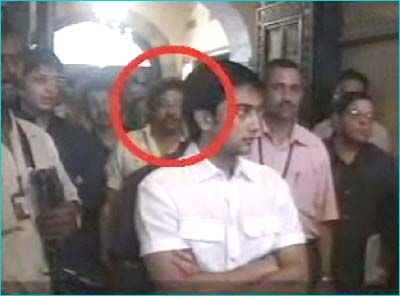
My latest peeve concerns the tendency of news videos to come with bright red lassos or arrows that move in relation to the video. Originally used to point our attention in grainy videos, this visual annotation now appears in almost every other news report. It is very reminiscent of the times when a similar 'innovation was handed to cricket commentators to emphasise some vague point they wanted to make. Invariably, the pointer would slip resulting in some unholy scribbles that even parents of kindergarten kids would be loath to praise.

The problem arises when perfectly clear pictures are defaced by a circle or an arrow. The end result is like watching the victim of a laser pointer attack - the poor chap has no idea a red circle is following him all over the screen. Worse are animated arrows that repeatedly keep poking the object of its affection - reminds me of all those "fling a shoe at Bush" flash games that did the rounds a few weeks ago.

This last mentioned menace appeared in a Times Now news report this evening about Sachin Tendulkar's absence from the next cricket match thanks to injury. In addition to a caption saying Internal Bleeding, an arrow kept poking at Tendulkar's rib cage. Despite the fact that it's internal. That we can eventually see him grimacing and holding his stomach. Forget about leaving it to the imagination, I haven't lent my eyes to Crimemaster Gogo to play marbles with. Another prominent member of the sac-red circle has been Ramgopal Verma while touring the Taj.

These marks have the unpleasant side-effect of instantly bumping anyone inside the circle to the level of an alleged criminal. What other conclusion could any visiting alien (from however advanced a civilisation) come to about a person thus outlined, other than he was worse than a dreg of Plutonic moondust: why else would the red circle keenly keep him in its sights like a hunting dog? To illustrate my point, see this composite image of the best of Indian TV (I hope NDTV doesn't sue me for saying that!): fine, upstanding journalists, with intensity and intent to break news written all over. And then observe, milord, the same exhibits with outlines straight out of The Omen.

You begin to sense the malignant cursors compelling you to haul them in front of the Inquisition. Brr.

Mar 8, 2009

The importance of an allegation

In recent times, eagle-eyed readers of the Times of India would have observed a curious typographical phenomenon in that newspaper. In stories such as this one about a crime in Pune, the word allegedly is italicised. Thus, in print, the article looks like this:
"The Haveli police on Saturday arrested Shekhar Shettiyar (28) of Kurla and booked five others for allegedly murdering Nathibai Chaudhary..."

"On June 26, 2001, the gang allegedly entered the shop posing as customers and stole the jewellery by threatening employees."

The motivation behind this oddity is unclear, and in the absence of the ToI style manual (if there is such a thing) in the public domain, it is hard to guess why this would be so. What is so special about the word "allegedly" that it needs to be highlighted thus?

Making it curious-er is the fact that there are many occurrences of the word in other ToI articles where it does not get such a treatment. Strange! (but not unusual for a paper whose curious 'case' of the perpendicular pronoun was remarked upon by this blog here.)

Notes
Incidentally, the ToI epaper doesn't provide the Pune edition any more, so I can't check if this formatting shows up in that version. It doesn't in the plain vanilla web version linked above.
Another blogger has made the very same puzzling observation.

Mar 6, 2009

Kaminey!

If you are a Vishal Bhardwaj fan but you haven't heard of Kaminey, you have got to read the Bardwatch here (or at George's).

Mar 1, 2009

Indian 'Word of the Year' - February updates

A note on the idea, words from Jan 2009, Feb 2009
February 2009's words

  1. Pink chaddis and other pinker-stinkers: February is the season of moralist protests in India, with forces for and against such manifestations of Western culture as Valentine's Day making headlines. This year took an unusual turn with a protest group launching a 'Pink Chaddi' campaign ('chaDDii'=='underwear') in reaction to an obscure radical group's actions. The coinage is clever and provocative, since it conjures up an instantly imaginable symbol and because 'chaDDii' is not always part of polite speech. From the point of view of this exercise, the phrase became even more interesting when counter-reactions applied the 'pink X' template to other apparel, including prophylactics. Is pink on its way to becoming the colour of Indian feminist action?

    Incidentally, the phrase moral police ought to be sent into some sort of Indian-ism 'Hall of Fame'. Though a phrase that is seen throughout the world, we seem to be the most fervent users of the phrase, as evidenced by a couple of anecdotal tests. 90% of the first three pages of Google search results for the word are India-related; this is also true of an archival news search.

  2. Jai Ho!: Remember Chak De? A phrase that sports crowds shouted lustily, a phrase that became synonymous with a coincidental and short-lived revival of Indian hockey, a phrase that hardly anyone uses. Does a similar fate await the aptly titled refrain from the Oscar winning song from Slumdog Millionaire (which also gave us another candidate last month)? The phrase, which is easy to utter and not unfamiliar to Indians, appeared in some newspaper headlines unrelated to the film . Just how much damage the constant drone of TV stories on the Oscar triumphs have done to us will be clear in a year's time.
A question to sign off: some of us have been using Slumdog as a sly euphemism to refer to scatalogical situations, usually to piss off our queasier colleagues. Tell me if you have noticed anything like this elsewhere.
January 2009's words

  1. Slumdog: a word that still has no entry in most dictionaries but shot into prominence after Danny Boyle's film and has even caused a lawsuit. Wow! An auspicious start for this list.
  2. 'Emosanal'/Emotional atyaachaar: A fertile phrase, coined by lyricist Amitabh Bhattacharyya director Anurag Kashyap, from the film Dev.D's soundtrack. I have seen several variants of this on some forums and music channels, using the phrase as X atyaachaar, which suggests a possible snowclone.
The fact that both of the above are connected to films says a lot about us Indians (or perhaps just me). We'll see how things evolve in the rest of this year.


The Whys
As a language and trivia enthusiast, I've always followed the American Dialect Society's Word of the Year. Why not an Indian Word of the Year?

Instead of trusting my cheese-like memory at the end of the year, it would be easier to record possible candidates along the way. This also opens up the possibility that some random observer will correct errors and add to the list.

What qualifies to be the Indian Word of the Year? I'm looking for interesting words or phrases that have been sufficiently interesting or news-worthy. This is not to be confused with a pure term-based 'Zeitgeist' - so Satyam will not be considered. Newly coined words will be invited. I'm also looking for words with 'potential' - that people mutate or mix with other words to form interesting variants. Perhaps even phrases that can become snowclones. So if people start making interesting things out of the word Satyam, then I'll include it. I admit I don't have it all figured out, but will do so as I do this.

Only English words? Not really. But limited by my own readings, my candidates are likely to be limited by language and geography. I'm hoping I'll be pointed to words by others.

For instance:
In Dec 2008, the relatively unknown phrase non-state actor would have been on the list.
In 2004, feel-good factor would have shone right in.
In addition, we would have take note of dard-e-disco last year - a strange phrase with some flexibility for reuse.

So to summarise: words that are interesting, not just news topics; words that have character; words that have newly entered our lexicon, and so on.

Feb 26, 2009

A Red Reading Room

"No weapons", he said.
I believed him.
I was a fool.

"We're gentlemen", he said.
I agreed.
He wasn't one.
(Don't believe that doctor.)

"By the ledge".
"Doesn't the spray make it slippery?".
He smiled and shook his head.

There I was, defenceless, staring into a Smith and Wesson.
"Jump", said Sherlock Holmes to me.

Feb 25, 2009

RMIM Puraskaar 2008 - the results

The soundtrack of Rock On emerged as the top Hindi film album of 2008 after a painstaking process of selection for the RMIM Puraskaar 2008. Academy Award winner (yay!) A.R.Rahman won Best Composer, while Javed Akhtar won Best Lyricist. The awards are a labour of love by Vinay Jain, who was kind enough to invite me to participate in the process as part of the jury (not that I have great music appreciation skills, but I am an enthusiastic listener :-)). I and 11 others spent about a month listening to the 70-plus shortlisted songs (see note on nomination process here), rating them on their individual components of music, lyrics, and singing, as well as the song as a whole.

Though lengthy, this was a highly enjoyable task and resulted in many fascinating questions on what I look for in a film song, and what kind of subliminal biases and preferences were in operation.

Vinay took our individual scores and comments, and compiled a list of winners in various categories. The results can be viewed here (the Hindi version here). The complete list of songs also contains comments made by various jury members. You'll spot that we were a varied bunch - mixed feelings were articulated and that is true of all listeners like us.

My picks for some of the categories were different, so even though these results show what the collective scores say, there is room for dissent. But I definitely agree with the decision not to award the Satish Kalra Sammaan to any 2008 film album. It was a relatively weak year for Hindi film music, despite its few bright spots. (In comparison, 2009 is already off to a smashing start with Dev.D and Delhi 6, with Vishal and others waiting in the wings).

Before I move on to reveal my personal picks, I would like to remind readers of that one of the principal aims of the puraskaar is "to have a review of the year's music and document it for posterity." (read this post for the whole premise). So, if you would like to record your opinions and disagreements, do send feedback to Vinay [giitaayan at gmail dot com] or leave a comment. Would love to hear them. The complete set of scoresheets is not available (I myself haven't seen any of the others) and is left to the discretion of the jury individual members to make available. I'd be happy to send my scores and comments to anyone who wants to have a dekko at them. Vinay's announcement on RMIM covers a few such details.

My own pick for top album was Jodhaa Akbar, which was a very tough choice to make out of my four candidates: Jodhaa Akbar, Jaane Tu..., Rock On!!, and Aamir. My summarised comments on these :

Aamir: had superb lyrics and very good music, especially for a debutant film music composer. It also had depth, with its lyrics forming a partnership with the music that was greater the sum of their parts. I thought it fell short on breadth, that's all.

Rock On!!: interesting concept, nice texture, loved the female solos; the lyrics and the singing (though acceptable for the film's concept) were where it went down a notch. Especially as in comparison to the others. I didn't give it the benefit of a 'rock' album, choosing to apply more conventional hindi film music parameters.

Jaane Tu...: like the film, the album went in familiar territory but managed to come out fresh. Full of pastel colours. But inherently, it didn't have the same depth for me. Perhaps it wasn't meant to.

Jodhaa Akbar: perhaps not everyone's choice of top album. IMHO, there was a lot of inventiveness in this particular album, especially in taking a period piece and applying modern touches to it - which needed some guts. As a result, this album sounds different from other Rahman 'period' soundtracks. The lyrics were competent, the arrangements superb, the melodies dulcet, and embellished the movie well.

Obviously, this is just a point of view. The exercise also illuminated the fact that despite what we hear on FM stations, a lot of decent Hindi film music gets made in one year, and sometimes there are quite a few minor gems that never get the attention they deserve. If a selection like this enables one to broaden one's mind just a touch, it'll have achieved some of its aims.
Previous results: 2006 and 2007
With thanks to friends who responded to a straw poll on Best Album

Feb 18, 2009

He's always on a tangent

The adventures of English in India have always been exciting to observe. Yet another reminder was served up today when a colleague received a rather innocuous email:
Dear [so-and-so],
Please find the attachment of resume. He is my cosine brother. He is in a software Eng.
One could not help but laugh (Harish had tears streaming down his face).

On reflection, this spelling makes a lot of phonetic sense. Initially, I thought this was a case of "when spell-checkers go wild". But thanks to the wisdom of "English is a very funny language" (a.k.a अंग्रेजी बड़ी अवैज्ञानिक भाषा है), I can see why there would be quite a few Indians making that mistake (as this Google search shows).

Thanks to Niranjan for inspiring the headline

Feb 17, 2009

Caliban's Sunrise

In Jeeves and the Feudal Spirit, that whiskered pill Percy Gorringe recites a poem about a man who, while watching the sun go down, comments:
"I say,
Doesn't that sunset remind you
Of a slice
Of underdone roast beef?"

Caliban at Sunset
I'm sure if Stilton Cheesewright, 'soulless clod' extraordinaire and muse for the poem, was to see this image of the morning sky from a few months ago, it would doubtlessly remind him of some scrambled eggs.

Feb 16, 2009

Tube Tales

In 1999, the London Magazine Time Out invited its readers to provide ideas for stories based on real life experiences in an around the metro's famous Tube. Eventually, this turned into Tube Tales (official link) - 9 little tales on the underground rail.

Most of the stories are brilliant, both in narration and content. Those rocking coffins have inspired a variety of minor sagas, differing in flavour and treatment. That famous names appear on-screen and behind the camera only enhances the appeal.

To choose from, there's the squirmingly funny H0rny (potentially uncomfortable if you have XY chromosomes!), the musically eloquent Bone (directed by Ewan McGrrreggorr), or the very clever Mr. Cool (Kelly Macdonald as the object of his attention) that opens the compilation. There are comic and dramatic twists, unexpected losses, the supernatural, and the poignant (like Jude Law's A Bird in the Hand). Add to them the pulsating background score.

Highly recommended (warning: NSFW at times). My viewing was courtesy the local British Library, but some of the segments may be available at online video shares.

Feb 15, 2009

The music of Delhi 6, mere yaar

Hardly a month into 2009 and there have been two outstanding Hindi film soundtracks already. While Dev.D burst into the room and grabbed us by the scruff of our necks, A.R.Rahman's latest, Delhi 6, fluttered in through the window with a fragrant breeze. Here's why.

A credits page to weep for
The album's credits has a power-packed batting order: Mohit Chauhan opens with a bang. Javed Ali & Kailash Kher at one down. The music director snatching a dreamy song in the middle. And then all the cameos: the uber-talented Rekha Bhardwaj. A blast from the past in the voice of Ustad Bade Ghulam Ali Khan. Amitabh Bachchan rounding things off. There's even Rajat Dholakia in the background as well.

Unusual, unpredictable, and largely unmatchable.

Dove, oh dear
It takes but a few seconds into masak kali to know this one is up there in Rahman's all time best, which is an astonishing feat even for the man himself. A splendidly onomatopoeic avian paean (take a bow, Mr. Joshi), Mohit Chauhan and the now-trademark accordion (played by Rahman) vie for top honours here. If ever there was a modern song made for Kishore Kumar (something Salil also observed), it was this one. Adding to nostalgia is the old device of the violin-backed lead-ins. I always wish I could find an instrumental dissection of songs - this one in particular.

The best explanation as to the meaning of the term masak kali came from Vibhendu: masak is a term for the roof (a.k.a the chajjaa). Thus, the eponymous pigeon is literally the the bud/darling of the terrace.

Another Rahman trademark is that of the Sufi song. So remarkable has he been in this genre, that a Rahman sufi/qawwali/devotional top 10 is merited. arziyaa.n would comfortably fit into the top echelons of such a list. Many of the others showered praise; this qawwali pleads for succour. Prasoon Joshi's notes for this song in the inlay (a nice touch that) say it was almost a year before he finished writing the lyrics for this tune. With phrases such as marammat muqaddar ki kar do, the time spent was well worth it.

Like khwaaja mere khwaaja, these songs are all about 'feeling'. The singers nail it. The ending with the Bulleh Shah kaafi mora piyaa ghar aaya is neatly placed.

Electric guitars and the rhesus factor
The title song is as far removed from the previous two as one can get. The French lyrics and drawn out female vocals, the electronic modulations, the clever hooks in lyrics and music - very snazzy. kala bandar is interesting: one is prone to dismiss it on a superficial level: we are quite conditioned by the mindless use of rap in Hindi albums. But the lyrics, loaded with some kind of political metaphor, deflect that simple interpretation. This song comes closest to the "the journey within" sub-title of the film. This causes some disorientation in our story expectations: along with the 'ramleela' scenes and the film sub-species of the returning NRI, are we in for a revisitation of the Swades territory?

Continuous delight
dil giraa dafatan taught me a new Urdu word (dafatan means 'suddenly', my dictionary informs). Ash King sings, croons, touches the falsetto ceilings, returns and dwells. The string section breaks out in a lush Celtic melody. There is no full takeoff - the singers soar and swoop. I wrapped my head round this to make sense. Many have spoken of how Rahman and Vishal subvert the traditional grammar of Hindi film music. This song is part recital, not full-blooded Bollywood song. As was rehna tu

The obvious faults in Rahman's Hindi diction are always overshadowed by the sheer sincerity in his singing. That he turns rehanaa tuu into rainaa tuu hardly matters when there are so many interesting elements dotting the canvas. Such as the guitar riff in the background, or the way the singing begins in the middle of the beat cycle, or the lyrics themselves (liked the imagery of people right-hand-in-right-hand).

My big complaint of the album was the lack of an instrumental track. But the 2 minute piece at the end of this song assuages this. Rahman's interest in The Continuum has been noted on this blog earlier and he chose a spectacular way to introduce it to Hindi film music. From what I know, the continuum is after all just an electronic synthesizer whose resulting instrumental feel can be controlled - say, strings or woodwind or others. Here, he goes in for an ethereal flute-theremine sound, playing it with great élan over 2 minutes in a Carnatic classical vein. Goosepimply stuff.

Special appearances
I've yet to get over the disappointment of finding out that Rekha Bhardwaj did not have any Rahman originals to sing. She features in two traditional songs ('supervised' by Dholakia): a smartly mixed folk song gendaa phool (intriguingly, a 'courtesy' credit to Raghuvir Yadav) and a bhajan. A similar effort is Shreya Ghoshal 'jamming' (as the inlay notes put it) with the voice Bade Gulam Ali Khan - a very interesting concept. Wonder what shape it takes on screen.

There's just 50 seconds of Amitabh Bachchan reciting a short ghazal called Noor, but that was enough to make me smile in contentedly. In 17 years, A.R.Rahman has never composed music for an Amitabh Bachchan film (discounting such narrations as in Lagaan or Jodhaa Akbar), and this guest appearance (in film and voice) is the first.

And so...
Delhi 6 is easily a career highlight for the composer and the lyricist. The album is not just figuratively heavy, but literally so, with an actual mirror on the front side! An 'in-your-face' rendering of the introspection referred to in the movie sub-title. A satisfying musical effort that awaits a similar outcome on-screen this Friday.

Feb 9, 2009

'Blood Brothers' - a little film by Vishal Bhardwaj

Blood Brothers is one of four films made for the Bill and Melinda Gates Foundation as part of the AIDS Jaago project on the subject of AIDS awareness. Directed by that unheralded master, Vishal Bhardwaj, this short film of less than 20 minutes is a marvelous piece of drama. Featuring a top cast of Siddharth, Pavan Malhotra, Ayesha Takia, and the peerless Pankaj Kapur (with whom Vishal seems to have a special 'setting' - such is the charm of his cameo), the film has some excellent story-writing.

Without ever tresspassing on 'preach'-ery, the film works both as a piece of socially relevant material as well as pure story-telling. If all this wasn't enough, perhaps you may be interested in the facts that the film was shot by Guillermo Navarro (Pan's Labyrinth among others) and is based (partly) on a story idea by screenwriter Matthew Robbins.

The film can be viewed online. While you are at it, have a look at the others in this pack of four (Mira Nair, Farhan Akhtar and Santosh Sivan completing the quadruple).

Feb 8, 2009

Choices

Choices are infuriating. Hard to tell if they were right. Can't tell what success rate one has at making various choices. Especially those that are hard to explain or have no precedents. Those made from a flash of intuitive reasoning (or so one imagines) and not just a random popping of neurons.

No what-if projections either, of what things would have been like if a different path of the fork had been chosen.

So at the end of it all, how do you know if you're falling or still on your feet?

Feb 5, 2009

Kala Ghoda Arts Festival 2009

The Kala Ghoda Association Arts Festival is currently in progress. A detailed list of activities (as sent out by the Literature Curating team (many of them from Caferati)) can be found below. There are (English/Hindi/Marathi) workshops (for children and adults), writing contests, performances, and also a Lit quiz by our friends from the Bombay Quiz Club.

Here you go:


We have a bunch of writing-related workshops and participatory events for children and adults at Kala Ghoda this year. For more information and information on how to register, please follow the links below.

A series of fun, interactive sessions for children of different ages A Mystery for MindNuts

What If? An introduction to the World of Speculative Fiction (All children's events are in English.)

Some stuff for people who may be of voting age but who still want to learn and have fun doing so.

Translating Marathi Poetry (in Marathi and English)
Writing Fiction (in English)
Creative Writing (in Marathi)
Art Criticism (in Marathi)
Freelance Journalism (in English)

Also on the cards:

- A workshop in Hindi, an introduction to the art and craft of writing for TV serials. As soon as we have the details, we'll post it to the Kala Ghoda Gazette. You'll find the announcement filed under Workshops & Seminars. - A Literature Quiz. If this works out, there will be a short preliminary round, open to all, where you will have to answer a questionnaire. The winners of that round will go through to the live quiz. We'll post this to the Gazette too, if it works out, under Contests. Speaking of contests, if you subscribe to the Caferati Contests newsletter, you already know about this, but just in case.. Our very popular contests for writers are now open to entries. The deadline for submissions is the end of the 8th February, 2008. Here are the links for more details: Poetry Slam

Jan 31, 2009

Sundaram has served his last great meal

The actor Nagesh, one of the greatest I've seen, passed away earlier today. He remained active, especially in Kamalahassan movies, almost till the end (according to Wikipedia, his last release was Dasavatharam).

Nagesh's genius for comedy and pathos, drama and character, put him, IMHO, in the Chaplin league. Hindi film watchers may have seen Mehmood portray several Nagesh roles in Hindi remakes, including the role of the waiter in Main Sundar Hoon (Server Sundaram) and the madcap wannabe director (complete with horror narrator) in Pyar Kiye Jaa (Kadalikka Neramillai).

A detailed tribute at PFC provides a glimpse of how wonderful the actor was. A theatre in the T.Nagar area of Madras, named after and owned by the actor, was the closest to home when I lived there, and where I saw a few films, including Devar Magan. That theatre was a minor geographical entity, but the man was a pint-sized movie landmark.

Jan 29, 2009

Bomb-Holé

An astonishingly common typo seen these days is the use of the word "diffusing" in the context of taking the fizz out of a bomb. Google returns 41,700 search results for "diffuse bomb". Even respected newspapers occasionally spread the shrapnel, as seen in this article (unless the man quoted saying that spelt it out for the reporter).

I hope it doesn't gain currency like "revert". That would make it a deficult situation.

Jan 28, 2009

Slumbi, race ka ghoDaa

If, like me, you wondered what the fuss about Slumdog Millionaire was, then you could blame the Indian film industry.

Here's why. I have spent about two and a half decades in the generous bosom of Indian films, or Hindi & Tamil films to be precise. We learnt us how to appreciate these movies. Training our neo-cortex to take in the bloodless dishum-dishum, where henchmen respectfully awaited their turn in being beaten up by a hero who was in a much lower weight category1, where Landsteiner's divisive blood groups freely mixed, and the locked up heroine always sprawled across the bed in a diagonal direction.

When we asked how does the hero know which hospital to go to?2, the wise answer came: the director must have told him.

Add to this situation, the parallel cinema movement of the 80s (which came with a governmental guarantee that women would get molested, children would die of hunger, and there would be no songs). These came into prominence once a year when the National Film Awards were announced.

Therein lies our Slumdog dilemma. When you grow up with two sets of film philosophies, one engineered for entertainment and escapism and the other for awards, you can't easily reconcile the former type winning critical awards. Our 'commercial' filmmakers knew what end point to get to, and how to get us there. What if they broke half-a-dozen natural laws in getting there? We didn't complain about them not getting any awards - that wasn't their purpose in life.

Then we became tired. Guilty even of this naach-gaana. We learnt dismissive words such as 'kitsch' to keep them at arm's bay. Mostly, we wanted a change. Especially from cringing at watching befuddled foreigners3 staring in songs sung by Kumar Sanu4.

My examples of how movies that perfectly meshed entertainment and mental stimulation came from Hollywood, especially many of the Academy Award winning films. Then we learnt how those gongs get marketed and manipulated. We discovered great movies that even the American public didn't like. We learnt to use our own eyes and minds.

Now, most mainstream Hindi film makers are deliberately ironic about what can only be termed as 'heritage'. The best directors now don't make movies like in the 70s and 80s, and thankfully so. That's a deliberate act of (r)evolution. Each year, we make some films, that in our own estimation, can stand up to any of the best that we've ever seen from the West.

So it's hard to go ga-ga about a film that embodies so many bad habits of the Hindi films of our growing years. Yes, the cinematography is good, the pace is far from leisurely, the kids are fresh, the background score is pulsating. But then, like the Bollywood tradition it channels, SDM suffers from the oldest groan in the book: what George calls the Sagging Second Half syndrome.

SDM makes a chinese bhel of the NP-complete Indian languages resolution problem, serves up one of the most ineffective Hindi film gangsters of all time, and ends with a song that even Sunny Deol could have choreographed better. But largely, it's the extra masala thrown in to suspense-ify the film: the live telecast of the TV show, the chance to break off post-question-pre-answer (hurt my quizzing sensibilities), meet me at VT (where - it's such a big station!) and so on. That made-for-all seasons answer bubbled up when we complained: oh, come on! how did that happen?. The answer was: it was written. In the screenplay."

A pity. It's a clever story. But we've seen the treatment before. My complaint to the Academy is: if this was the filmi angle you wanted, you should have told us before, no? We could have arranged for it earlier, cheap price only, better quality maal. The resulting attention that some of our best creatives have receive is welcome. But the affair has confused us5.

A final point:
To those here who complain about poverty and exploitation: break the give me. Our own movies are still full of exploitative material.
Danny Boyle, against whom much of these charges have been leveled, can probably take solace in one of the long standing traditions of the Hindi masala. That of the villainous angrez, whose backside must be kicked by the end of the movie, preferably when he's trying to escape with the gems via helicopter. Jai Bajrangbali to you.

No, one last, god-promise last point:
Leaving the primary role of film awards to reward movies aside, their legacy is to serve as some measure of the quality of films in a year and to serve as one source of recommendations for the future. This episode also reveals the utter paucity of trustworthy Indian movie awards, which is why any tizzy at the Oscars - a Hollywood exercise - gets our blood pressure high.

Update
1. Matthew Schneeberger says it much better than I ever could.


1.: Unless of the Sanjeev Kumar mould.
2.: Not to be used for mai.n kahaa.n huu.n, which was largely rhetorical and equivalent to "good morning".
3.: Who wondered why Govinda was romancing Karisma Kap[oo|u]r instead of Himani Shivpuri, who was in his own weight category.
4.: That's Padma Shri Kumar Sanu to you.
5.: I didn't think much of last time's Oscar for Best Film either, for different reasons.

Jan 27, 2009

Roger Federer, my new Tendulkar

For a period beginning from the earlier part of this century to about a couple of years ago, my viewings of Sachin Tendulkar batting went like this. As soon as the great man walked in, a stomach-full of butterflies danced their unholy steps - so keen was I for him to do well and to prove each detractor (death to them!) wrong. Sometimes, it came off, but many times, it didn't. The only positive was that the butterflies would immediately vacate said space to leave a brief emptiness.

Until a Zen-like realisation dawned that allowed me to accept and appreciate whatever Tendulkar provided each minute in the middle. Subject sometimes to the moods of the jealous sporting gods. Irrespective of large or infinitesmal.

It worked, because now, it doesn't matter all that much. And he's enjoyed an 'nth' Australian summer.

For the greater part of the last tennis season, Roger Federer became my new Tendulkar. It was painful to watch, not because he was hitting balls into the net, but because a figurative string had snapped in that divine racket. The most recent illustration came on Sunday, when Tomas Berdych walked in and snatched two sets without leave or license. The butterflies ordered some more nectar and boogied away.

Hard to say exactly what impression the next three sets had. The man who played, nay sweetly horsewhipped, Juan Martin del Potro today had absolutely no effect on my stomach, apart from causing satisfaction that I doubt even a gourmet meal at The Ritz would come close to matching. The second set - the first of two bagels of the match - was sufficiently sublime for us to congratulate del Potro on managing to take three games in the first set.

In fact, let's digress to pay a tribute to del Potro, the recipient of a sympathetic near-apology from the man on the other side. Those very same sadistic sporting gods chose you because someone had to be on the other side of the net. No one deserves that. Despite your own lux-quotient (you are #6 in the world, remember), the light at the other end was a pleasantly blinding experience. You are more than someone who had to serve every other game, more than a straight man in the wrong kind of act, more than a hula hoop for a God. You deserve to star in your own YouTube videos, rather than a hapless cameo in someone else's.

Yes, I'm getting 'kinda' cocky. Blame it on Roger Federer, who even chose to head a ball across the net than merely accept yet another point won via happy slaughter. Who knows, I might even hex him in the semis. But the mood he was in today was a return to the days that made grown tennis players want to speed-dial their moms so that they could weep into their laps.

Naturally, it's appropriate that his semi-final opponent is Andy Roddick.

Jan 26, 2009

26th January, 2009

Continuing the series.

How to assess the progress made in addressing the the November attacks on Bombay? There have been a lot of stories across the month from newspapers and magazines (IMO, they have been doing a good job of reporting related stories). However, finding this information in one place, say on a newspaper's site, is very difficult. I wonder if someone has a blog or webpage chronicling some of the serious reports and opinions to come out. If not, someone should. This Wikipedia article is the best we have now.

***
A quick wonder as to whether the people who said they would keep returning to the Gateway of India until concrete steps have been taken, are doing so? Or if they are reasonably satisfied that things are changing for the better. Hard to tell.

***
Several police and security personnel who died in the fighting that day have received India's highest peace time gallantry award, the Ashok Chakra. There were the inevitable bureaucratic murmurs - how do they really assess someone's contribution, how could they leave one out if a similar other was included, and so on. That these honours are awarded only to individuals and not to groups is a pity. Isn't an NSG commando who is fortunate to successfully finish the operation and to come out alive also worthy of great praise? Is bravery only determined by certain kinds of circumstances? The good thing has been that for a change, these men have become household names. We don't do enough to highlight the rest's contribution in non-glamorous situations.
***
The TOI reports that funds allocated to the Maharashtra police were "diverted" to housing and vehicle issues rather than buying equipment. Buying sleek vehicles is obviously a luxury that can be postponed, but I'm not sure housing should necessarily be considered a lower priority as the article claims. Policemen at lower ranks and their families don't always live comfortable lives; these are issues of morale and economics that have as much impact on a policeman's likelihood of avoiding the temptation of corruption and be mentally available for a demanding job.
***
A minor step in improving the NSG's response times comes from them now being allow to requisition private aircraft if necessary. And there's a new RAW chief.
***
In an interesting conversation with Shekhar Gupta, the Home Minister says he is working as per a 150 day plan, mentions an acronym-filled (almost Yes Ministerial) project called the National Population Register, and made this important point:
SG: And citizens also learn that there is a price to pay for security.
PC: There is a price to pay. You have to accept some inconveniences. The same citizen who goes to the US and willingly removes his jacket, shoes etc. shouldn’t complain if he is frisked here. I think we must get over some of the bad habits that we have allowed to grow in the last few years[...]
People complain when they are frisked, people complain if they are stopped at the check post, people still jump red lights at night. All that must go.
Made me think: we go hoarse demanding politicians, police, customs et al. do their duties. So that they protect our right to break a traffic signal in the middle of the day.
***
On the Pakistan front, Indians would have been happy to see the new White House go all bellicose on the issue of unilateral strikes. Almost immediately followed by conciliatory statements from Islamabad.
***
In the New Indian Express, Joydeep Nayak says the IPS has no standard operating procedures for different situations.
***
Finally, wondering if the Assam blasts earlier this month got a lot of mind space, or if it was 'business as usual' for the rest of us?

Next BC Quizzing Day

Two BCQC quizzes coming up on February 1st: all the details here. In addition, there are several other Pune quizzes happening in February, pointers to which can be found here.

Dal-chini bhai bhai

Chandni Chowk to China could so easily have been titled Singh is Qing.

Jan 14, 2009

Pune Music Circle is a very regularly updated blog about upcoming music events of all sorts in Pune. Quite useful.

Jan 13, 2009

Jan 12, 2009

'Interesting' is a stop word?

In language processing, a stop word is one that that has little to no importance in a certain task. Common examples are words like 'the' and 'of' in an Information Retrieval system, which is why a search engine ignores them by default. A routine measure of stop words involves frequency - words that occur too often are deemed to have lost their 'distinguishing power' and so do not provide any value while trying to identify the topic of a document or the opinions of a blog post.

To me, the word 'interesting' is teetering on the edge of usefulness. Earlier, when someone used the word, you could assume they found something worthy of curiosity. But, in many instances now, the word is used in a politically correct sense, usually as a response to the question: "so what did you think of that?"

If you don't possess the mordant wit of Dorothy Parker or the honesty of a child, you hem and haw and say: "Oh, um, it was interesting. Quite interesting.".

And "interesting" becomes consigned to the scrap heap of pointless patter.

Jan 11, 2009

"Pune’s Rosy Winters" - an article

The following formed the basis of an article about Pune in the winters that I wrote for the December edition of FlyLite, the in-flight magazine of the airline JetLite, which is put together by Spenta Multimedia. The content belongs to the publishers.

Pune’s Rosy Winters Once known for its historical traditions and now an educational and commercial hotspot, Pune rediscovers its roots each year in its invigorating winters.

There comes a day when the early rising Punekar will step out of his house, pause in slight surprise, and try to clear his eyes. When the blurriness remains, the Punekar realises that the light fog is to blame for the reduced visibility and that winter has arrived on padded feet.

Winter arrives quietly in Pune and is greeted with relief by the city, especially since an unpleasantly hot October is a common postscript to the rainy season. Pune has always lived, figuratively and literally, in the shadow of a metropolis that makes much of its monsoons. But winter is a season Pune can lay claim to as its own. Unlike the disruptive machismo of the Bombay rains, Pune's winter is gentle in both arrival and tenure, mirroring the laidback ways of the place. A trip down the sleek Mumbai-Pune expressway through the misty Western Ghats more than amplifies this difference.

In the Pink The phrase that the locals use to describe the first month of the winter says it all. Punekars bask in “gulaabii thandii”, literally the “rosy cold”. During this time, citizens, in their light woollens, can be seen bearing a light rosiness of both cheek and demeanour.

Since Pune's winters are temperate, especially in comparison with the frigid bitterness of many North Indian towns, they can rouse residents to action rather than cause them to cower behind a thick quilt. Once the indolence of the early cold morning is defeated, a walk in the balmy ambience is the best way to kick off a day. Given that parts of commercially booming Pune are sometimes bedevilled by smog towards the evenings, the mornings remain the best time to soak up the sun-kissed winter.

A favourite variation of this is to walk up the nearest ‘tekdi’ or hillock. Pune is blessed with an abundance of these easy-to-climb hillocks, which offer vantage views of the city, especially in the late evenings. Many of these tekdis have a temple at the summit, providing the spiritually-minded with a reward for their exertions. For the more material at heart, tekdis also offer flat summits for exploration, hot snacks and tea, and the pleasant company of fellow wanderers. Much higher than any tekdi is Sinhgadh on the outskirts of Pune which boasts of a legendary fort of the Marathas. It is a favourite with both trekkers and foodies. The traditional pithla-bhaakri or onion bhajjis washed down the special buttermilk gains a special tang after a pleasant wintry ascent.

Avian Season For those with their feet firmly on the ground, the season offers other charms. The many lakes in and around Pune receive several varieties of migratory birds. Chief among these are different kinds of ducks, geese, and herons. However, the chief headline-hoggers are pink flamingos that come in from the West and the North, via the Rann of Kutch. Apart from trekking expeditions, local adventure groups organise bird watching tours to places such as Pashan Lake, Bhigwan Dam, Kavdi, and Sinhgadh, and have inspired many an amateur ornithologist.

Cultural Capital Pune's cultural calendar is packed in the winter, with music events ruling the roost. The days during the festival of Diwali, especially the “Paadva” day, are marked by early morning classical music concerts by top musicians. However, the undisputed star on the cultural firmament is the “Sawai Gandharva Music Festival”.

The festival is named in memory of Rambhau Kundagolkar or ‘Sawai Gandharva’, a leading Hindustani classical music exponent of the 40s. Of the Kirana gharana, Gandharva tutored several students who later rose in musical prominence. Chief among these was the legendary Bhimsen Joshi. Led by him, these students started this festival, now over fifty years old, which always features a stellar list of classical musicians.

The event is held on three successive days, beginning in the afternoon and going on till well into the night. Held in the open with some partly covered areas, the result is a very unique experience for spectators. Sweaters of increasing thickness are worn as the evening wears on, blankets are used to reserve areas for groups to recline during the night, and a thermos is pulled out for tea & comfort. Municipal rules prohibiting shows past 10 o clock are cheerfully violated (permission is eventually granted). But nobody in the neighbourhood really minds, especially when some of the best musicians in the country are on stage.

The performers on the bill are usually singers and instrumentalists of various Hindustani classical music styles. The event also showcases leading musicians of the Carnatic form of classical music, and dancers. For each performer, an appearance at the Sawai Gandharva is a stern test in front of the connoisseurs, who have cast discerning ears at many a pretender over the decades. The Sawai is very much a home of music, especially an open-air, wintry one.

The fastidious Sawai attendee will tell you that for several people, the Sawai is the social event of the winter calendar. A chance to meet friends, and to have tea and snacks with them at 1 in the night. But for the average music lover, it is a once-in-a- year opportunity to hear some of the best sounds in the business, and to do it in the company of the stars above.

In recent times, a number of other cultural events have sprung up during the winter months, such as the Pune International Film Festival and the Pune Book Fair. Another festival-in-memoriam is “Pulotsav” which commemorates Pune's most favourite littérateur, P. L. Deshpande, or “Pu La” as he was fondly known. A man of immense artistic talents, a keenly observant Pu La used humor writing, theatre, film, poetry, and song to depict life around him in ways no one else has. This two-week festival is devoted to the arts, featuring Pu La vignettes as well as theatre, music, and reading performances.

Since winters in Pune rarely descend into single digit temperatures, the city is never hobbled by the weather. As January ends and the sun becomes less oblique, winter fades away just as gently as it arrived. Each year, the hard-to-impress Pune old-timer will insist that the city was not what it used to be. But come next November, this sentiment will be assuaged by the winters of Pune's content.


Notes
1. Thanks to Sumant for sending the publishers my way and Nikhil for his inputs.
2. While setting out to write this, I realised I knew hardly anything about Pune winters beyond the usual minutiae. There's quite a bit more to this place.
3. If you thought the title was slightly diabetes-inducing, I can explain.
4. Ironically, this time, the winter only showed up towards the end of December (and then with a set of frigid knives).

Jan 9, 2009

Death did them apart

A few days ago, I was reading this obituary of Harold Pinter. At the end of the article, this caught my eye:
Mel Gussow, a critic and cultural reporter for The Times, died in 2005.
The obit was written by Mel Gussow and Ben Brantley.

Obviously, Gussow had contributed to the obit a long while ago. Though seemingly morbid, keeping an up-to-date obituary of a notable personality even prior to his decease is common newspaper practice. That said, I haven't seen this inversion before.

Max Gussow was a NYT theatre critic, whose own obit can be read here. There's also this nice Washington Post article about the life of an obituary writer.

Jan 8, 2009

Mind culture

There came a point when I knew significantly more trivia about Bob Dylan, Pink Floyd, or Shakti, than much of their music. So it was only fair that I plough back some of my ill-gotten earnings into redressing this state of affairs.

So where does a newbie start but with so-called definitive collections? As long as I don't ask 'what need do I have of this' and 'that'.

Jan 7, 2009

RMIM Puraskaar 2008

Tired of the multitude of inconsistent (and plainly misguided) Hindi film music awards? The RMIM Puraskaars, an attempt to redress this imbalance, is accepting nominations for your favourite songs from last year.

The results from 2006 and 2007 should more than assuage any lingering doubts as to its musical tastes :-). The motivations behind such an exercise are available for perusal here.

One can nominate up to 30 songs (use this list of films from last year to jog your memory) and use the form at the end of this page. The poll is likely to remain open until the middle of this month.

Jan 6, 2009

Dev.D and Rule

People who know me will tell you I have probably never used the phrase "kick-ass" to describe anything. But there's a first time for everything. The music of Dev.D deserves that appellation. It's as if some rugby fly-half drop-kicked you right into the yonder sky. It's an enjoyable ride, by the way.

Amit Trivedi (music), Amitabh Bhattacharya (lyrics, along with Shellee and others), and Anurag Kashyap (director) manage to do three things: they exhibit a superlative range of genres, provide a solid texture (a mix of urban melancholy, mofussil brass, and quiet yearning), and most importantly, they demonstrate great faith in their choices. There are 18 tracks, and while some of them do falter, just taking the effort to put in 18 more-than-decent tracks (haven't seen that kind of depth and scale since Rahman's Bose) gives them many brownie points.

The list of my personal picks begins with the dulcet banaarasii Dhol yaaraa Dhol sung with great desire by Shilpa Rao and backed by Kshitij. Some of the turns gave me the kind of goosepimples that I usually get with some Rahman interludes. Raa.NjhaNaa is a small downbeat version of this song.

The album has many such doppelgangers - pairs of tracks taking gloomy/bouyant U-turns, hard rock/street music incarnations, or turning from joy to lament. The two Dev-Chanda Themes are especially interesting - the first is a slow bluesy hum (and a fine one at that) while the second is a very moody whistle with a touch of menace.

The album continues its excursions off the rails. There are a couple of Punjabi songs and a Rajasthani song mixed to club arrangements. Then there are a couple of songs that just don't seem to belong here. They're from some Indi-rock-pop album. It gets very difficult to mentally put this lot together - your mind has to make several leaps to reconcile them. What's uncanny about the soundtrack is how it keeps riding the waves of romantic exhilaration and cavernous dejection. Shruti Pathak's paayaliyaa is a great example of this.

Then come the songs voiced by Amit Trivedi - these tend to be garrulous (the harmonium-guitar fuelled duniyaa), scruffy rock (nayan, aa.nkh micholii), or dripping with melancholia (saalii khushi). He's off the sur in places, but that seems very calculated - or is it?

And at last, for the dhokhaa-daayak "emo[tio|sa]nal atyaachaar" songs. That phrase is so cheesy and so appropriate that it will turn into a worn-out cliché. Especially for the brass band version (an immaculate concept, if any), which on repeated hearings could so easily turn into hilarity by the time the movie hits the screens. That might actually work against the intended mood. Don't hear it too often if the song needs to retain its novelty freakness! The rock version is safer, with a great opening guitar riff and sung with throat-shattering gusto by Bony Chakravarthy.

Phew. Undoubtedly, there are a hajaar music influences at play in Dev.D's soundscape. I found myself thinking of fragments from several songs. In several places, the lyrics are both wonderful and with an original flavour. A loser's tale has seldom been more plunge-worthy. Whatever happens to his movies, Anurag Kashyap's track record in getting music that you can also touch and feel remains intact. In many ways, the follow-up to the collaborations with Vishal Bhardwaj is appropriate. Amit Trivedi's music is intertwined with Amitabh Bhattacharya's words in a wholesome concoction. Where did all these people come from, you wonder - these Labh Jajuas, Shilpa Raos, Shellees, Toshis and Aditis and Shrutis, Manis and Kshitijs, and most of all, these Amits? The efforts in composition, writing, performances boggle the mind.

An album so trippy, you find yourself on your backside often, staring into that strange sky. You bitch. Indeed.

A more detailed and appropriately awe-struck review here.

Jan 5, 2009

1.25 sessions at Sawai Gandharva 2009

I have been stepping up my Sawai Gandharva attendances in measured quanta - one session in 2005, a full day last year, and 2 days this year. Or that was the plan for this year, until I decided I had had enough this year after half of the last day and decided to retire hurt.

I've realised I don't really have much of an ear for the standard issue Hindustani classical concert. The template performance, with the lengthy warm-up aalaaps, made me fret. Or perhaps it was just the choice of performers. The trouble with Sawai is that the first few performances are either newcomers or slightly obscure musicians. In comparison to the big names, they don't seem to tailor their recitals in accordance to the audience's mood (or in response of the lack of one). Contrastingly, all the Carnatic musicians I've seen at Sawai have gone out of their way to engage with the listeners, either by useful explanations of what they're about to do, or by picking attractive compositions. It could be that they have to put their best foot forward, being mostly novel to the average attendee.

It could just be my South Indian ear, brought up on idli-dosai at home and pongal-coffee at the Chennai winter sabhas (which I hated to attend as a ten year old at the peak of my neighbourhood game). But those with me seemed to concur. I enjoyed the programme last year. This time, Ganesh-Kumaresh and Pandit Jasraj (who clearly knows how to recruit the audience on his journeys, and did some interesting harmonic bits with his pupils, whom he also sledged from time to time) were the highlights. Even the usually appealing Ronu Majumdar couldn't hold my interest.

Or it was the crowds. The Bhaaratiya Baithak (you sit cross-legged, Indian-style) is a pain in the arse, quite literally, and especially so when there's hardly room for the occasional stretch or back-lean. Your mind gets into a sitting-marathon mode and at some point you hit the wall. I spent the rest of the Sunday morning (lasted about 3 hours in the BB) standing. There's got to be a rethink about some of the organisation - the place is splitting at the seams. Or an extension of the shamiaanaa on either side is needed. I sat under the stars last year till 2 am and ended up with a massive cold in return for watching the astonishing L. Subramaniam and his son.

On the sidelines, there was an excellent photo exhibition featuring the latest Bharat Ratna, Pandit Bhimsen Joshi (who made an appearance and looked extremely frail, and so in no condition to repeat his short and sweet recital from last year). The highlight being a snap of a rather dashing Pandit Ravi Shankar.

Clamped up, I inevitably end up in a lot of soul-searching: what am I here for? Do I really "get" what the musician is trying to do? Am I, in Aditya Gadre's annoyed terminology, just a pseudo-fan (in its kindest interpretation). Are many of the people here just surfing the annual social waves or busy admiring the emperor's new clothes?

Anything to keep my mind off the pain that has oppresses the region from my lower back to the ankles like some mad despot.

This is a much kinder report by a Sawai debutant.

Jan 3, 2009

Balls, Ballots, Bollywood - Questions

In October, I did a quiz called Balls, Ballots, Bollywood (the Madhur Bhandarkar version would be called "Cricket, Politics, Films") which, I am sure, gave the participants lots of "emotional atyaachaar"[1] even before they knew such a phrase existed.

Anyway, questions from that quiz are now available - the details can be found here.

I did a couple of interesting things for and during the quiz, which you can read about it in two "Making of..." articles under this label. (for lack of Disc 2 of the DVD, the one with the special features and the secret out-takes).

1: How we needed that phrase. Its time has come.

Dec 27, 2008

Ghajini - the anti-review

Where am I? Who am I? More importantly, why am I wearing a purple jacket?

The last thing I remember is going into that indie theatre. This shifty-eyed bloke from Bradford gave me a ticket to this movie that he recommended. Have a look, curry-breath said. See if it reminds you of something.

It must have seared my memory, because all I feel now is this bloodcurdling intestinal rage. I felt a sticky something on my forehead. A Post-It. "jacket your Beneath." I wasn't in the mood for a prat's idea of a joke, so I crushed it into a ball and flung it outside the window. Which is when I looked at the ceiling. It read: "read everything in reverse, you eejit." There was even a footnote: ".above the except". I ran down and rushed past a bored looking receptionist.

After an hour's search, I found the crumpled note. Then, I thumped my head (made the throbbing worse) and opened my purple jacket. Tattoos all over. Garamond, 40 pt. This must have been serious enough to bear the cost and pain of the serifs.

(Where am I? It doesn't look like London outside. We don't have yellow taxis and hot weather.)

I have looked at all the words. Except the ones on the back. I now also have a sprained neck trying to get a look at my back. What I know so far is this: a severe trauma has left me leaking memory like a RAM chip made in China. I am tracking someone. To kill. Or at least to demand a lengthy explanation. Thanks to the spread needed for the large font size, all I can read of the people who left me in this state is: "...i of Mahmud" and "killed was meme..." I need a mirror.

After two hours of intense confusion, I realise I need two mirrors.

Update: my feet say the cryptic words IMDB and nm0634240. Also, I seem to be wearing lots of white make-up and a clown's lipstick.

From the newspaper, I have realised this is Bombay. Under the bed, I notice several polaroids of a short, dark, moustachioed man. He is always behind another short, fair man clutching several moustaches and scissors in his hand. My hotel is opposite a hairdressers'. Do these guys work there? Disturbingly, an arrow on one polaroid points to the dark bloke and says: "They complete me".

Who the heck am I? Like some strange bug, I've been following two people using a memory like a full-sized golf course. I have a framed postcard of a big mountain on the table that reads "remember?". I keep tossing and turning at night. Nor can I sleep in the day - my head hurts from the roars of a cricket match on the telly that has just begun. I feel like a canary in a magic trick - will I die or will I be revealed to the audience's cheers? It is day but I'm still in the dark.

I remember something. It wasn't an indie theatre, but an Indi-theatre. And songs were playing. One thing is for sure. I'm taking no prisoners.

The short men have walked out into the open. Time to go.